

Table of Contents
- Why Industrial First Aid Preparedness Starts With Risk Assessment
- Building a Workplace Emergency Response Plan That Works
- Your Industrial First Aid Kit Checklist and Maintenance Schedule
- First Aid Training and Refresher Training for Industrial Teams
- Running Emergency Drills and Measuring Readiness
- Conclusion
- Frequently Asked Questions
Last Updated: October 15, 2026
Why Industrial First Aid Preparedness Starts With Risk Assessment
Industrial first aid preparedness begins with a documented risk assessment, not a kit purchase. A proper workplace first aid risk assessment identifies what can go wrong, where, and how severe it could be.
The process follows a clear sequence:
- Identify hazards across every work area, from chemical storage to height access
- Assess the likelihood and severity of injury for each hazard
- Determine the number of trained first aiders and their locations
- Match equipment and training to the risks you’ve documented
- Review the assessment after any incident, near miss, or site change
Safe Work Australia’s model WHS laws require first aid equipment, facilities, and trained personnel, but the specifics depend on your site’s risk profile. A warehouse with forklift traffic needs different cover to one handling corrosive substances.
How to Calculate First Aider Numbers for Your Site
First aider numbers depend on workforce size, shift patterns, and hazard level, not a single national formula. Safe Work Australia’s First Aid in the Workplace Code of Practice provides a risk-based framework rather than fixed ratios.
The calculation works like this:
- Low-risk sites (offices, showrooms): roughly one trained first aider per 50 workers
- High-risk sites (construction, manufacturing, mining): roughly one per 25 workers, sometimes fewer
- Shift coverage: every shift, including night and weekend crews, needs its own first aiders
For a construction site with 60 workers across two shifts, that means at least four trained first aiders, distributed so no worker is more than a short walk from help.
Building a Workplace Emergency Response Plan That Works
A workplace emergency response plan turns your risk assessment into clear actions. It should be written, accessible to every worker, and practised, not filed away in a site office.
Your plan needs to cover:
- Who is in charge during a medical emergency, and who takes over if they are the casualty
- How to raise the alarm and contact emergency services
- Where first aid kits and AEDs are located
The plan should name specific roles, not just positions. “The site supervisor” is vague. “Sam, the leading hand on level two” is actionable. Name a primary and a backup for every role, because the person who normally calls Triple Zero (000) may be the person who is injured.
Incident Command During an Industrial Emergency
Industrial emergencies rarely involve a single casualty in an open yard. They happen on plant, in pits, on scaffolding, or inside tanks. Someone needs to run the response while others treat the casualty, and that person should be identified before the incident, not during it.
A simple incident command structure for a site first aid response looks like this:
- Incident controller, stands back, assesses the whole scene, makes decisions, and liaises with emergency services. This person does not treat the casualty.
- First aider(s), provide care within their training and scope.
- Scene safety officer, isolates energy sources, controls traffic, and confirms the area is safe for responders.
On small sites, one person may hold two roles, but the controller should never also be the treating first aider. Split attention is how scene safety gets missed and handovers become muddled.
Handing Over to Paramedics
A clean handover saves time and prevents repeated questions. Use a structured format so nothing is forgotten under pressure:
- Age and sex of the casualty
- Mechanism of injury, what happened, and when
- Injuries found, visible and suspected
- Signs and vital observations, level of consciousness, breathing, pulse, skin colour
- Treatment given, first aid performed, times, and any changes in condition
- Allergies, medications, and medical history if known
- Hazards still present at the scene
Write the times down as they happen. Paramedics will ask when the injury occurred, when first aid started, and whether the casualty’s condition has changed. A scribe with a notebook is worth more than a good memory.
Post-Incident Review and Corrective Actions
A debrief within 24 to 48 hours, while memories are fresh, is where preparedness improves. The review should answer:
- Did the alarm reach the right people quickly?
- Was the right equipment available and in date?
- Did first aiders have the skills the incident demanded?
Record each finding as a corrective action with an owner and a due date, and track it to closure. A debrief with no actions is a missed opportunity, and the same findings across multiple incidents mean the plan itself needs rewriting, not just retraining.
How to Raise the Alarm and Hand Over to Emergency Services
Raising the alarm quickly and handing over cleanly to paramedics saves time when it matters. The sequence is straightforward.
- Assess the scene for danger to yourself and others before approaching
- Call Triple Zero (000) or delegate someone to call while you attend to the casualty
- State clearly the location, nature of the injury, number of casualties, and any hazards
- Stay on the line until the operator tells you to hang up
- Send someone to meet the ambulance at the site entrance and guide them in
- Hand over with a brief, factual summary: what happened, when, what first aid was given, and any changes in the casualty’s condition
Your Industrial First Aid Kit Checklist and Maintenance Schedule
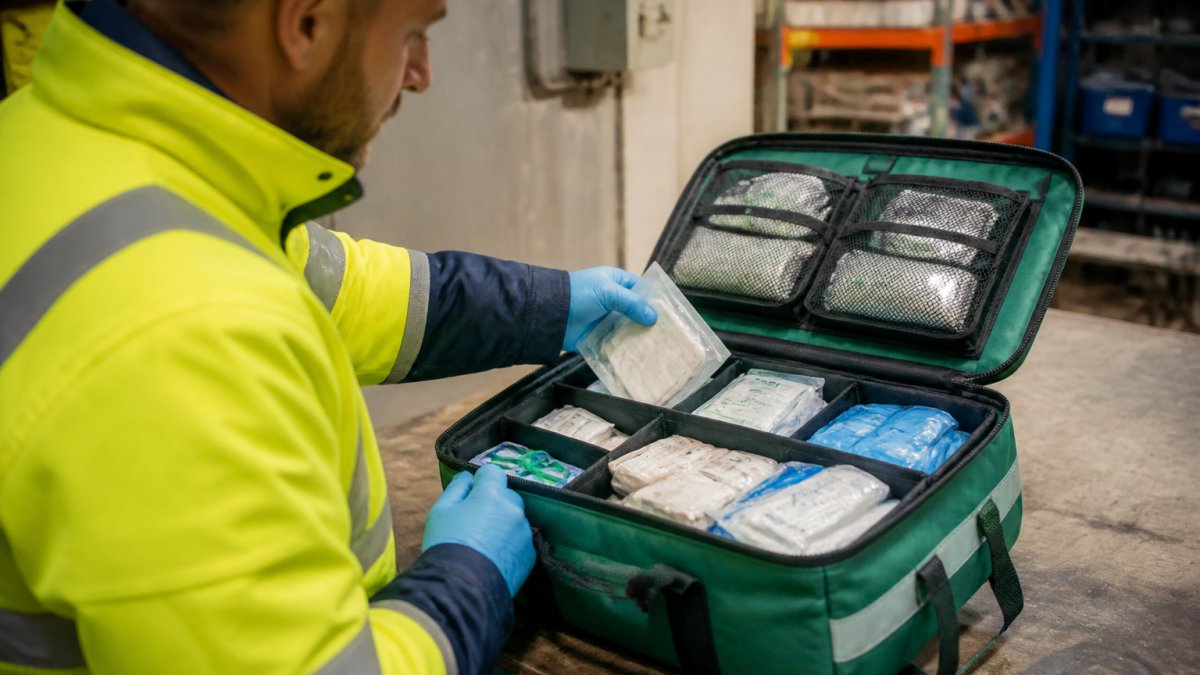
An industrial first aid kit is only useful if it’s complete, in date, and reachable. Kit contents should reflect your risk assessment, not a generic off-the-shelf box.
Core contents for most industrial sites:
- Adhesive dressings in assorted sizes
- Sterile gauze swabs and non-adherent dressings
- Crepe and conforming bandages
Kit inspection and maintenance schedule
|
Task |
Frequency |
Who |
|---|---|---|
|
Visual check of kit location and seal |
Weekly |
Area supervisor |
|
Check expiry dates on sterile items |
Monthly |
First aid officer |
|
Full stocktake and restock |
Quarterly |
First aid officer |
|
Review contents against risk assessment |
Annually |
WHS manager |
|
Replace used items |
After every use |
Anyone who uses the kit |
Restocking is the step most sites neglect. A kit used six months ago and never refilled will fail when it’s needed.
Hazard-Specific Equipment for High-Risk Sites
Standard kits don’t cover every industrial hazard. Where your risk assessment flags specific dangers, add the equipment those hazards demand.
- Chemical exposure: eyewash stations, emergency showers, specific antidote information, and safety data sheets
- Welding and hot work: burn gels, sterile burn dressings, and eye irrigation
- Height work: spinal immobilisation equipment and training in its use
The equipment is only half the answer. Workers need to know it exists, where it is, and how to use it.
Photograph your kit layout and pin the photo inside the lid. When someone needs a burn dressing at 2am, a visual map beats rummaging through compartments.
First Aid Training and Refresher Training for Industrial Teams
First aid training gives workers the skills to act, and refresher training keeps them current. Nationally recognised first aid certification typically runs for three years, with CPR refreshers recommended annually. For industrial teams, training should be built around the hazards your risk assessment identified, not a generic classroom syllabus.
Matching Training to Your Hazard Profile
Different industrial hazards demand different competencies. Chemical storage needs confident eye irrigation and decontamination; height work needs spinal care and packaging for transport; plant and machinery needs crush injury and severe bleeding control.
A practical way to map this is to list your top hazards and, against each, name the specific skill a first aider would need to manage the worst realistic outcome:
- Machinery and crush injuries, catastrophic bleeding control, tourniquet use where trained, casualty packaging
- Electrical incidents, safe isolation, rescue from live equipment, CPR and AED use
- Chemical exposure, eyewash and emergency shower operation, safety data sheet interpretation, decontamination
If your training provider cannot tell you how their course addresses these, the course is probably not industrial enough.
Competency, Not Just Certification
A certificate proves someone attended, not that they can perform under pressure. Industrial sites benefit from verifying competency separately from certification:
- Scenario assessments, run a simulated incident and observe whether the first aider follows the right sequence
- Skills checks, CPR compression depth and rate, AED pad placement, tourniquet application, bandaging
- Equipment familiarisation, can they find the AED, open the kit, and locate the burn dressing without hesitation?
These checks take minutes and reveal gaps a certificate hides.
Refresher Cycles and Skill Fade
Skills fade faster than certificates expire. A worker who trained two years ago and hasn’t practised since will hesitate. A common pattern on industrial sites is:
- Annual CPR refresher for all first aiders
- Scenario practice at least twice a year on high-risk sites
- Full requalification on the standard certification cycle
Shift-based workforces make this harder. Night crews, fly-in fly-out rosters, and rotating contractors all need coverage that doesn’t depend on a single training day. Scheduling refreshers into shift handovers, pre-start meetings, or toolbox talks keeps the cycle alive without pulling people off the job.
Eyzon Health & Safety delivers nationally recognised first aid training with flexible online and face-to-face options, and same-day certificates on successful completion.
Running Emergency Drills and Measuring Readiness
Emergency drills test whether your plan works in practice, not just on paper. A drill that runs smoothly on paper can fall apart the moment someone has to find an AED under pressure.
Run drills that cover:
- A simulated medical emergency with a designated casualty
- Alarm raising and emergency services contact
- First aider response and handover
Measure readiness with a few simple indicators:
- Time from incident to alarm raised
- Time from alarm to first aider on scene
- Percentage of workers who know where the nearest kit and AED are
Track these over time. If response times creep up or kit checks keep finding problems, your preparedness is slipping.
Don’t run drills as a box-ticking exercise. If workers know the exact scenario in advance, they rehearse memory rather than response. Vary the scenario and the casualty’s location each time.
Conclusion
Industrial first aid preparedness is a system, not a purchase order. It starts with a genuine risk assessment, flows into trained people and stocked kits, and stays sharp through drills and refreshers.
If your site needs nationally recognised first aid training that reflects real industrial conditions, Eyzon Health & Safety can help.
Get started with Eyzon Health & Safety and give your site the preparedness it deserves.
Frequently Asked Questions
What should an industrial first aid plan include?
A complete industrial first aid plan covers your risk assessment findings, the number and location of trained first aiders, kit contents and inspection schedules, your workplace emergency response plan, and how you raise the alarm and contact emergency services. It should also name who holds current certification, how refresher training is booked, and how drills and post-incident reviews feed back into the plan so it stays current as your site and hazards change.
How do you assess first aid needs in an industrial workplace?
Start with a workplace first aid risk assessment. Walk the site and record every hazard: plant and machinery, electrical work, hazardous chemicals, heights, confined spaces and remote or lone work. Then factor in workforce size, shift patterns, distance to medical help and the presence of contractors or visitors. The result tells you how many first aiders you need, what equipment to stock, and where kits and trained staff should be positioned across the site.
How many trained first aiders should a workplace have?
Numbers depend on your risk level, workforce size and shift coverage, so there is no single figure that fits every site. High-risk industrial settings generally need more first aiders than low-risk offices, and you must cover every shift, including night work. Aim for enough trained people that someone is always available without leaving their post, plus backups for leave and turnover. Your risk assessment and the relevant WHS guidance determine the final number.
How often should workplace first aid kits be checked?
Check kits regularly rather than once a year. A practical routine is a quick visual check after every use, a monthly review of stock levels and expiry dates, and a full audit each quarter. Record who checked the kit, what was restocked and what was discarded. Heat, dust and moisture on industrial sites degrade supplies faster, so inspect more often in those conditions and replace anything damaged or expired immediately.
What first aid training is suitable for industrial workers?
Industrial workers need training that covers CPR, automated external defibrillator use, bleeding control, wound care, burns, fractures, shock, choking and eye injuries, plus how to raise the alarm and hand over to emergency services. Look for nationally recognised courses delivered by an accredited provider, with hands-on practice scenarios. Refresher training keeps skills current, and workers should practise on the equipment and kits actually used on their site.
How can a workplace prepare for first aid emergencies across different shifts?
Map your roster against first aider coverage so every shift, including nights, weekends and overtime, has trained people on site. Position kits, automated external defibrillators and communication equipment where each shift can reach them quickly. Run drills at different times of day, not just during day shift, and include contractors and casual staff in inductions. Review coverage whenever rosters change so gaps never go unnoticed.