

Table of Contents
- Face-to-Face Training vs Online Learning: The Core Differences
- Benefits of Face-to-Face Training
- Advantages and Disadvantages of Online Training
- Online Learning Effectiveness for Different Skill Types
- Blended Learning: Combining Both Formats
- How to Choose the Right Training Format for Your Needs
- Frequently Asked Questions
Last Updated: October 12, 2026
Face-to-Face Training vs Online Learning: The Core Differences
Whether you’re delivering workplace safety, professional development, or skill acquisition training, the choice between face-to-face and online learning shapes everything that follows.
Face-to-face training is instructor-led learning in a physical classroom or training space where participants and trainers interact in real time. Online learning is remote, self-paced or scheduled instruction delivered through digital platforms, where learners and instructors connect asynchronously or via video calls.
The real difference isn’t location, it’s how feedback happens, how complex skills transfer, and what environment keeps learners focused.
Benefits of Face-to-Face Training
In-person training drives outcomes through real-time feedback, hands-on practice, and human connection, most valuable when stakes are high or skills are complex.
Real-Time Feedback and Instructor Interaction
Face-to-face learning puts you in direct contact with an instructor who watches what you’re doing, spots mistakes instantly, and corrects them before bad habits form, critical for safety-critical skills where a single error can cause harm.
A trainer watching you perform a technique sees your approach, hesitation and confidence level, and adjusts their explanation on the fly. Questions get answered immediately, with the whole group hearing the answer.
According to research on learning and development effectiveness, real-time feedback significantly improves skill retention and reduces the likelihood of practising incorrect methods.
:::pro-tip Instructors with hands-on trade experience, like the trainers at Eyzon Health & Safety who bring 10+ years of site experience, can spot the small details that textbooks miss. They’ve seen what goes wrong in real workplaces, not just in theory.
Hands-On Practice for Complex and Safety-Critical Skills
Some skills can’t be learned from a screen, you need to physically practise them and experience mistakes safely.
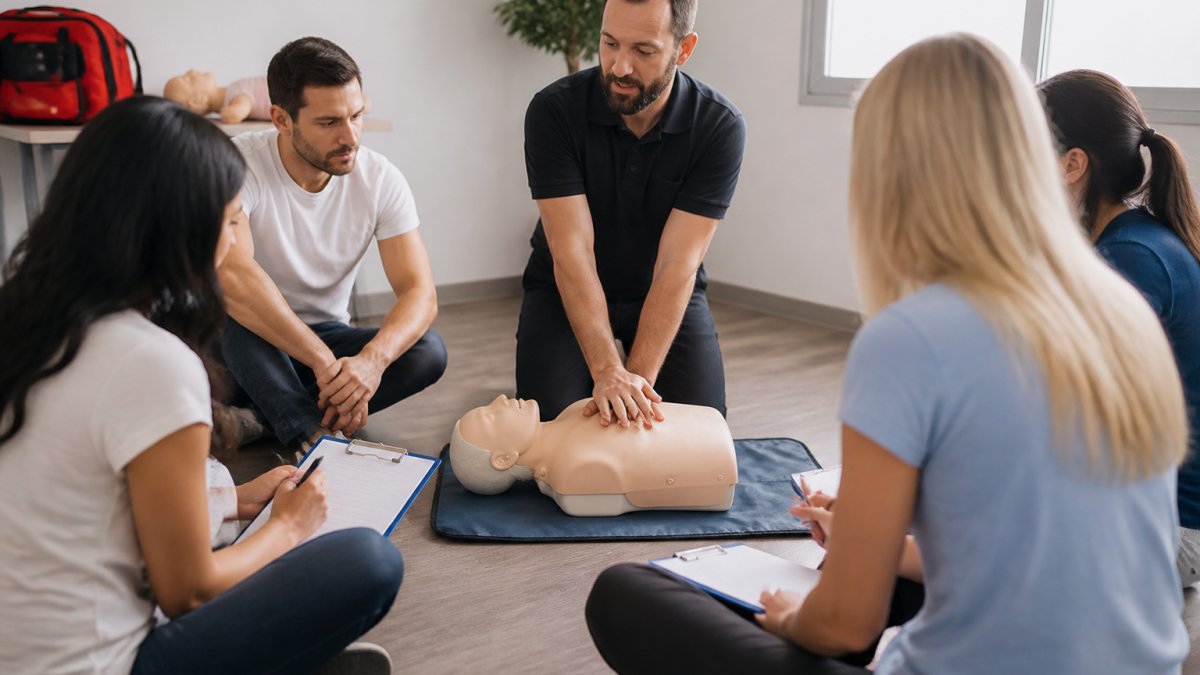
Safety-critical skills, first aid, hazard identification, emergency response, demand hands-on practice. You need to feel how to position a casualty, gauge chest compression pressure or move an injured person safely; watching a video isn’t the same as doing it under supervision, where an instructor corrects your form and builds your confidence.
Peer Interaction and Collaborative Learning
When learners share a space, group energy and peer interaction become part of the learning, you see how others approach problems, hear different questions and draw on collective experience. Social learning is a recognised mechanism for knowledge transfer: classroom discussion, group problem-solving and informal peer feedback happen naturally in person, with shy learners gaining confidence watching others and confident learners deepening understanding by explaining concepts.
Advantages and Disadvantages of Online Training
Online learning removes location barriers and offers flexibility face-to-face training can’t match, but it trades real-time interaction for convenience, and that trade-off doesn’t suit every skill or learner.
When Online Learning Excels
Online learning is genuinely effective for knowledge-based, theoretical or foundational learning, if the goal is understanding concepts, absorbing information or preparing for assessment, remote delivery works.
Flexibility is real: learn on your schedule, pause to review difficult sections, revisit content as needed.
Accessibility improves dramatically, learners in remote areas, with mobility challenges or irregular schedules can train without travel, and organisations delivering across multiple locations cut costs and coordination complexity.
Limitations of Remote Learning for Practical Skills
Online training struggles with practical, hands-on skills: you can’t learn a physical technique by watching a video, or feel the feedback your body needs to adjust your approach. Engagement and motivation often decline remotely, without classroom structure, peers and real-time instructor interaction, some learners procrastinate, lose focus or skip difficult sections, while home distractions multiply. For safety-critical skills, the lack of direct supervision is a genuine risk: no instructor to watch your technique, correct your form or intervene before you hurt yourself or others, and self-assessment is unreliable because learners often think they understand a skill until they try it under pressure.
Online Learning Effectiveness for Different Skill Types
Not all skills are equal, online learning works well for some and poorly for others.
Knowledge-based skills (regulations, company policies, theory) transfer well online, learners can read, watch videos, take quizzes and demonstrate understanding without physical practice.
Low-complexity procedural skills (checklists, software, sequences) can work online if content is clear and assessment thorough, though a live demonstration still improves outcomes.
Safety-critical skills must include direct observation and assessment: an instructor watching you perform the skill, confirming correctness and signing off your competence.
Blended Learning: Combining Both Formats
Blended learning is often called “the best of both worlds”, true only when the split is deliberate. Done badly, it produces the worst of both: learners arrive unprepared, classroom time becomes content delivery, and nobody practises anything.
The design question isn’t whether to blend, but which parts belong in each mode.
What belongs online
- Pre-course knowledge, terminology, regulations, background theory and the “why” behind a procedure. Delivered asynchronously, this lets learners work at their own pace and revisit anything unclear.
- Knowledge checks, short quizzes confirming the pre-work landed, giving the instructor a diagnostic picture before the room fills up.
- Refresher and update content, regulation changes, revised procedures and periodic knowledge top-ups, where the learner already has the physical skill and only needs information refreshed.
What belongs in person
- First exposure to a psychomotor skill, the initial demonstration and supervised attempt, so learners see the technique performed correctly then feel it for themselves.
- Corrective feedback, an instructor watching a learner and adjusting their approach, which can’t be replicated asynchronously.
- Scenario and pressure practice, running the skill under realistic conditions, with complications introduced deliberately.
A workable sequence
The pattern that holds up across safety, trade and professional contexts runs in four stages:
- Asynchronous pre-work, knowledge and theory completed before the practical session, with a clear expectation that it’s not optional.
- Knowledge check, a short assessment gating entry to the practical component, or at minimum flagging who needs support.
- In-person practical, demonstration, supervised repetition, scenario practice and direct assessment. Classroom time is spent doing, not listening.
- Post-course reinforcement, spaced online content, refresher modules and reference material, timed weeks after the practical session rather than days.
Sequencing matters more than the ratio: a course that’s 80 per cent online can outperform a 50/50 split if the online portion is genuinely preparatory and the in-person portion genuinely practical.
Where blended delivery earns its place
- Dispersed workforces, a large multi-region cohort can complete theory remotely and travel only for the practical component, usually the shortest part of the course.
- Continuous onboarding, asynchronous pre-work lets new starters begin immediately rather than waiting for the next classroom date.
- Mixed accessibility needs, learners who find a full classroom day difficult can complete more of the course in a format they control, while still meeting the practical requirement.
Where blended delivery goes wrong
- Pre-work treated as optional. Learners arrive without the foundation, the practical session becomes a lecture, and hands-on time evaporates.
- Classroom time used for content delivery. If the in-person session is mostly slides, the blend adds cost without value.
- No link between the modes. Online modules and the practical session must reference each other explicitly, or learners treat them as two unrelated courses.
:::pro-tip When designing a blend, write the practical session first. Decide what absolutely must be observed in person, then work backwards to determine what the learner needs to know before they arrive. This prevents the common mistake of building online content first and then trying to fit practical activities around it.
How to Choose the Right Training Format for Your Needs
Most comparisons stop at “it depends”. A decision framework is more useful, work through the five criteria below in order, and the first hard constraint usually settles the question.
Step 1: Classify the learning objective
Be specific about what the learner must be able to do afterwards, not what they must know.
- Recall and comprehension, regulations, policies, terminology, theory. Online delivery usually suffices.
- Procedure with a fixed sequence, checklists, software, forms. Online can work if assessment is rigorous, but a live demonstration lifts accuracy.
- Psychomotor skill, anything requiring coordination, force, positioning or timing. This needs supervised repetition.
If the objective spans more than one category, consider blended delivery rather than a single format.
Step 2: Assess the consequence of getting it wrong
Ask what happens if a learner is signed off as competent but isn’t.
- Low consequence, a reporting error that gets corrected. Online assessment is defensible.
- Moderate consequence, equipment damage, rework, service failure. Some supervised practice is prudent.
- High consequence, injury, exposure, fatality. Direct observation by a competent assessor is the baseline expectation, and often a condition of site access or insurance cover.
This is where many well-intentioned online programs fail: the content may be excellent, but the assessment method can’t demonstrate what actually matters.
Step 3: Map the learner profile
Format suitability varies as much by learner as by subject.
- Self-regulation, can this person block out time, resist distraction and finish without external structure? If not, asynchronous delivery underperforms regardless of content quality.
- Confidence in group settings, some ask questions freely in a room; others find a chat box less intimidating. Neither is better, but the mismatch is costly.
- Language and literacy needs, a learner reading English as a second language may follow a demonstration more easily than a dense written module, or vice versa if the written material is well-scaffolded.
Step 4: Test the logistics honestly
- Travel and time away from the job, calculate the full cost, not just the course fee. A one-day course can consume two days of productive time once travel is included.
- Geographic spread, for a dispersed workforce, bringing everyone to one location may be the single largest cost line.
- Connectivity and device access, online delivery assumes reliable bandwidth and a suitable device. Where that isn’t guaranteed, a classroom removes the variable entirely.
Step 5: Decide, then design for the format you chose
The common failure is choosing a format then delivering it as though it were the other, a lecture recorded and uploaded, or a classroom session spent reading slides aloud. Design has to match the medium.
|
Decision driver |
Points to face-to-face |
Points to online |
Points to blended |
|---|---|---|---|
|
Learning objective |
Psychomotor skill, judgement under pressure |
Recall, comprehension, theory |
Mixed objectives |
|
Consequence of error |
High |
Low |
Moderate to high |
|
Self-regulation |
Low |
High |
Variable |
|
Accessibility needs |
Hands-on equipment required |
Needs flexible pacing or reduced sensory load |
Both |
|
Travel burden |
Low or acceptable |
High or prohibitive |
High, with a small practical component |
|
Cohort size and spread |
Small, co-located |
Large, dispersed |
Large, dispersed, with regional practical days |
|
Assessment requirement |
Direct observation |
Knowledge testing |
Knowledge online, practical in person |
A note on measuring whether the choice worked
Whichever format you select, decide up front how you’ll judge it. Useful measures include assessment results, completion rates, how quickly learners reach independent competence, and, most tellingly, whether the skill shows up in workplace behaviour weeks later. Immediate post-course confidence scores are the least informative measure, because they mostly reflect how enjoyable the session felt.
Frequently Asked Questions
Is face-to-face training more effective for practical skills?
Yes, for hands-on and safety-critical skills, face-to-face training typically delivers better results. Learners can observe techniques in real time, receive immediate corrections, and practise under direct supervision. This direct feedback and peer interaction improve knowledge retention and workplace application, particularly for complex tasks where mistakes carry safety or performance consequences.
What are the benefits of face-to-face training compared to online?
Face-to-face training offers real-time feedback from instructors, immediate answers to questions, and collaborative learning with peers. Learners experience better engagement and motivation in a shared environment. For technical or safety-critical subjects, in-person instruction allows hands-on practice, demonstration of proper technique, and the group energy that supports learner focus and knowledge transfer to the workplace.
How effective is online learning for mandatory certifications?
Online learning effectiveness depends on the subject. For knowledge-based content and theory, online delivery is highly effective and offers flexibility and convenience. However, for certifications requiring practical demonstration—such as First Aid or safety-critical construction skills—online components work best when combined with face-to-face assessment or hands-on practice. Many accredited providers now use blended models to balance accessibility with skill development.
Can I do safety training online and still get a proper qualification?
Yes, provided the training provider is accredited and the course structure meets national recognition standards. For theory-based content, online delivery is fully recognised. However, practical components like First Aid or complex safety procedures often require face-to-face assessment or demonstration. Check with your training provider about their delivery model and whether it meets your workplace requirements and industry standards.