

Table of Contents
- Why First Aid Courses Matter in Aged Care
- Aged Care First Aid Requirements: What Employers Expect
- HLTAID011 Provide First Aid: The Core Qualification
- CPR Training for Aged Care Workers: Skills That Save Lives
- First Aid Certificate Renewal: Staying Current and Compliant
- Choosing the Right Course Delivery: Online, Face-to-Face, or Blended
- Common Mistakes and What to Avoid
- Frequently Asked Questions
Last Updated: October 12, 2026
Why First Aid Courses Matter in Aged Care
First aid courses for aged care are no longer optional, they’re essential infrastructure for anyone working with older adults. The reality is stark: aged care environments present unique medical challenges that standard first aid training doesn’t always address. Older people experience falls differently than younger populations, medication interactions create unpredictable emergencies, and recognising subtle signs of stroke or cardiac events requires specific knowledge.
At Eyzon Health & Safety, we empower students with the practical skills and certifications needed to succeed, ensuring a seamless, professional, and high-quality learning experience. That confidence translates directly into faster response times when emergencies happen. The difference between someone freezing in a crisis and someone acting decisively often comes down to whether they’ve had hands-on training that prepared them for that exact scenario.
Employers in aged care settings expect their staff to hold current, nationally recognised first aid qualifications. It’s not just a box-ticking exercise. When a resident experiences a medical emergency, the staff member who knows CPR, recognises the signs of a stroke, and can provide initial care before the ambulance arrives is the one who saves a life.
Aged Care First Aid Requirements: What Employers Expect
Most aged care employers won’t hire you without proof of current first aid certification. That’s not an exaggeration, it’s a compliance requirement under WHS legislation and a practical necessity in disability support and community care settings. Employers need to know their staff can respond to medical emergencies, and they verify that through nationally recognised qualifications.
The specific requirements vary slightly depending on your role and the type of aged care setting. A personal care attendant in a residential aged care facility faces different emergency scenarios than someone working in community care or disability support.
Employers also expect you to understand incident reporting and the practical steps that follow an emergency. After you’ve provided initial care, you need to know how to document what happened, communicate with ambulance officers, and support your team through the aftermath. That’s part of the job, and it’s part of what good first aid training covers.
Your certificate is typically valid for three years. Employers will ask to see it during onboarding and may ask for evidence of renewal before it expires. Some aged care providers ask staff to renew early, before the three-year mark, to ensure there are no gaps in coverage.
HLTAID011 Provide First Aid: The Core Qualification
HLTAID011 Provide First Aid is the nationally recognised qualification that aged care employers expect. It’s the standard across the sector, if you’re working in aged care and need a first aid certificate, this is the one you need. The qualification sits within the nationally recognised training system and is delivered by accredited RTOs (Registered Training Organisations) across the country.
What HLTAID011 Covers
HLTAID011 covers the practical and theoretical knowledge you need to provide first aid in a workplace setting. The course includes CPR, recognising medical emergencies, managing injuries, and providing appropriate initial care. For aged care specifically, you’ll learn how to respond to situations that are common in that environment: falls, medication-related emergencies, signs of stroke or cardiac events, and how to communicate with older adults who may be confused or anxious.
The practical component is where the real learning happens. You’ll practice chest compressions on a CPR manikin, work through scenario-based situations, and get feedback from your trainer on your technique. That hands-on experience is what builds the confidence and muscle memory you need when a real emergency occurs.
The theoretical component covers the anatomy and physiology behind first aid responses, legal obligations, and how to document and report incidents. You’ll understand why you’re doing what you’re doing, not just how to do it.
Who Needs This Qualification
If you’re working in aged care, whether as a personal care attendant, support worker, community care worker, or in a residential aged care facility, your employer will expect you to hold HLTAID011. It’s the standard qualification for the sector. If you’re training to enter aged care, getting this qualification early gives you a competitive advantage when applying for roles.
Family members providing care to older relatives sometimes pursue this qualification too. It gives them the skills and confidence to respond if something goes wrong, and it demonstrates to healthcare professionals that they understand basic emergency response.
CPR Training for Aged Care Workers: Skills That Save Lives
CPR (cardiopulmonary resuscitation) is the skill that gets the most attention in first aid training, and for good reason. Cardiac events are common in older populations, and knowing how to perform effective chest compressions and rescue breathing can keep someone alive until the ambulance arrives.
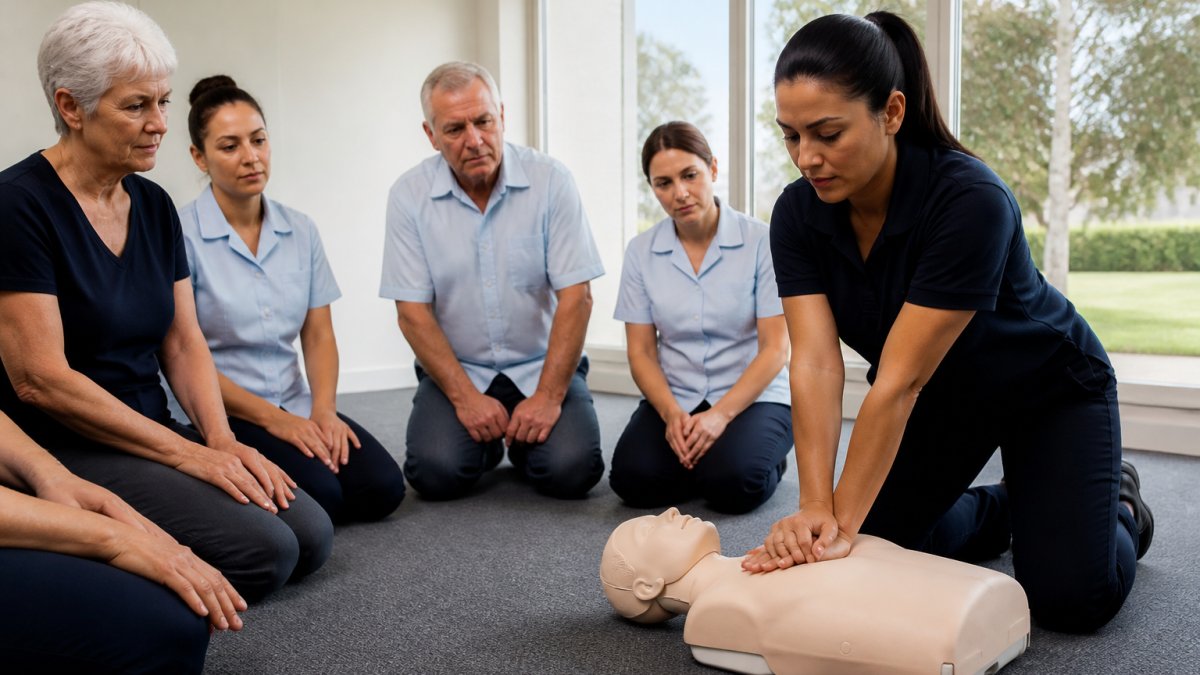
In aged care settings, CPR training takes on added complexity. Older people often have fragile ribs, existing cardiac conditions, and medications that affect how their body responds to resuscitation.
The practical experience matters enormously here. Performing chest compressions on a CPR manikin feels different from what you might imagine. Your trainer will correct your hand position, your compression depth, and your rhythm. By the end of the session, you’ll have the muscle memory and confidence to perform CPR effectively if you ever need to.
Many aged care facilities have an AED on-site. Your training will cover how to use it, when to deploy it, and how it integrates with CPR. The two work together: CPR keeps blood flowing to the brain while the AED attempts to restore normal heart rhythm.
First Aid Certificate Renewal: Staying Current and Compliant
Your first aid certificate is valid for three years. After that, you need to renew it to stay compliant with employer requirements and WHS obligations. Renewal is straightforward, you complete a refresher course that covers the same content as the original qualification but moves at a faster pace because you already have the foundational knowledge.
Renewal courses typically take less time than the initial qualification. You’ll still get hands-on practice with CPR and scenario-based training, but the theoretical component moves faster. Most people find the renewal process less intensive than their first course, which makes sense, you’re not learning from scratch.
The timing of your renewal matters. Some employers ask staff to renew a few months before expiry, so there’s no gap in coverage. Others are flexible as long as you renew before the certificate expires. Check your employer’s policy and plan accordingly.
Refresher training serves another purpose beyond compliance: it keeps your skills current. Medical guidance changes, techniques evolve, and a refresher course ensures you’re following current best practice. It’s also an opportunity to ask questions about scenarios you’ve encountered in your work and get guidance from a trainer who has current expertise.
Choosing the Right Course Delivery: Online, Face-to-Face, or Blended
First aid training is available in multiple formats: fully face-to-face, fully online, or blended (a mix of online and in-person components). Each has trade-offs, and the right choice depends on your learning style, schedule, and what your employer requires.
Face-to-face training is the traditional option. You attend a session at a training venue, work through scenarios with a trainer and other participants, and get immediate feedback on your CPR technique and first aid responses.
Online training covers the theoretical component remotely. You work through modules on your own schedule, which suits people with irregular work hours or those who live far from a training venue.
Blended delivery combines both: you complete the theory online at your own pace, then attend a shorter in-person session for the practical component.
Your employer may have a preference. Some aged care facilities require face-to-face training for all staff. Others are flexible as long as you hold a current, nationally recognised qualification. Check what your employer accepts before you enrol.
Eyzon Health & Safety offers both face-to-face and online options, so you can choose the delivery method that fits your schedule and learning style. The same nationally recognised qualification is available through either format, the difference is how you access it.
Common Mistakes and What to Avoid
The most common mistake is treating first aid training as a box-ticking exercise. You get the certificate, and then you forget most of what you learned. That defeats the purpose.
Another mistake is waiting until the last minute to renew your certificate. If your certificate expires and you’re between jobs or your employer suddenly asks for proof of currency, you’re in a difficult position.
Some people choose the cheapest training option without considering quality. A lower price might reflect shorter training duration, less experienced trainers, or less interactive content.
Not asking questions during training is a missed opportunity. If a scenario doesn’t make sense, if you’re unsure about a technique, or if you want to know how to adapt something for the specific aged care setting where you work, ask.
Finally, don’t assume that one first aid course is enough for your entire career. Medical guidance evolves, techniques improve, and refresher training keeps you current.
First aid training in aged care is an investment in your capability and your employability. It gives you the knowledge and confidence to respond when emergencies happen, and it demonstrates to employers that you take the job seriously.
Frequently Asked Questions
What first aid course is suitable for aged care workers?
HLTAID011 Provide First Aid is the nationally recognised qualification designed for aged care settings. It covers emergency response, CPR, AED use, and managing common health conditions in older adults. Many employers also recommend additional training in dementia awareness and falls prevention. Your course provider can advise on specialist modules relevant to your specific aged care role.
Do aged care workers need a first aid certificate?
Most aged care employers require staff to hold a current first aid certificate as part of workplace compliance and duty of care obligations. Aged care facilities must meet standards that include staff competency in emergency response. Check your employer’s specific requirements, as some roles may require additional certifications beyond the basic first aid qualification.
How often should aged care workers renew first aid training?
First aid certificates typically remain valid for three years. Many aged care employers recommend refresher training annually or every two years to keep skills sharp and stay current with best practice. Renewal ensures you’re familiar with the latest protocols for managing medical emergencies and responding to age-related health risks in your workplace.
Does aged care first aid training cover CPR?
Yes. CPR is a core component of HLTAID011 and all accredited first aid courses. Aged care-focused training emphasises CPR techniques suitable for older adults, including considerations for frail individuals and those with existing health conditions. You’ll learn both manual CPR and how to use an AED (automated external defibrillator), which is essential equipment in aged care settings.
Can I do first aid training online and still get a nationally recognised certificate?
Many providers offer blended or online-first delivery, but practical skills like CPR must be demonstrated in person with a qualified assessor. Online modules typically cover theory and knowledge, while practical sessions are conducted face-to-face or in small groups. Check that your provider is an accredited RTO and that the course leads to a nationally recognised statement of attainment.
What makes a first aid course nationally recognised?
A nationally recognised course is delivered by a registered training organisation (RTO) and leads to a statement of attainment for the relevant unit of competency (such as HLTAID011). Look for accreditation from the relevant state training authority and confirmation that the course meets Australian Qualifications Framework standards. Your employer or regulator can verify whether a course meets their requirements.
How long does an aged care first aid course take?
Most HLTAID011 courses take one to two days for full completion, depending on the provider and delivery format. Some providers offer accelerated or part-time options spread over several weeks. Online components may be completed at your own pace, with practical assessment scheduled separately. Check with your chosen provider for exact duration and scheduling options.