

Table of Contents
- First Aid Pro vs St John: An Overview
- First Aid Pro vs St John: Side-by-Side Comparison
- First Aid Course Duration and Delivery Options
- Workplace Health and Safety Compliance: What Your Certificate Must Cover
- Matching Your Learning Style to the Right Provider
- Which Provider Fits Your Situation?
- Frequently Asked Questions
Last Updated: October 4, 2026
First Aid Pro vs St John: An Overview
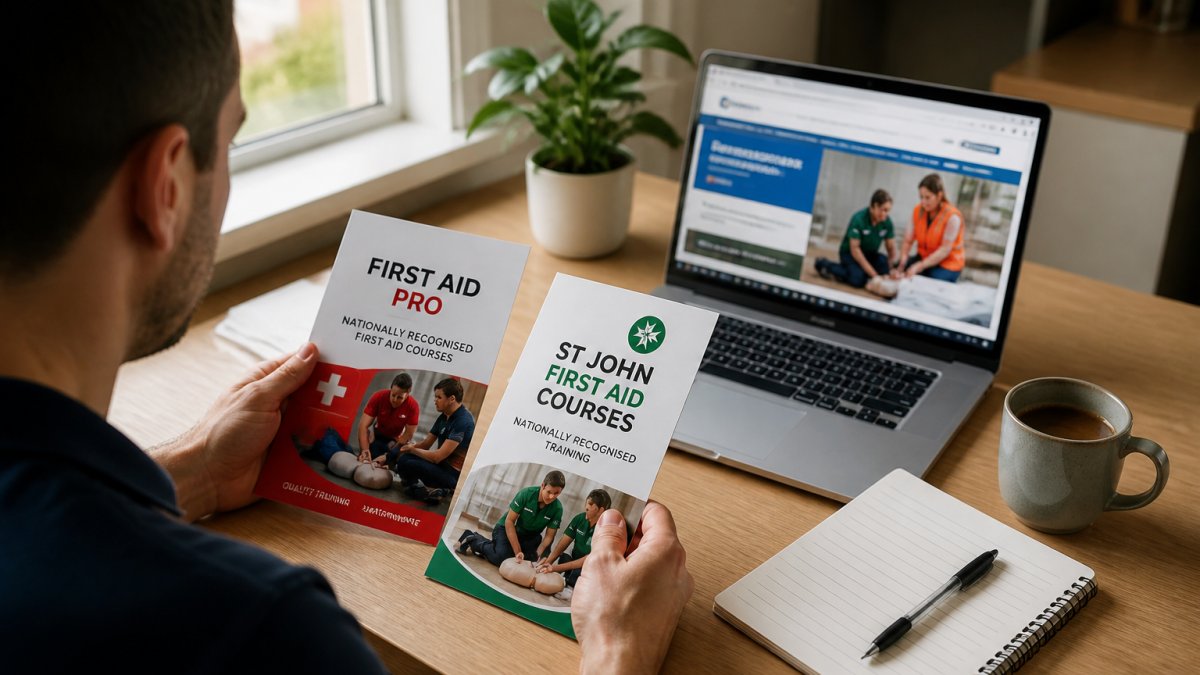
Choosing between first aid pro vs st john comes down to a simple trade-off: one competes on price and convenience, the other on brand history. Both deliver nationally recognised training, but they serve different learners.
First aid training is a regulated product in Australia. Every certificate you earn must map to a unit of competency from the national training package, most commonly HLTAID011 Provide First Aid.
That single fact should shape your whole comparison.
Below, we compare both providers against the criteria that decide real outcomes: accreditation, course duration, delivery options, practical assessment, and learning style fit.
First Aid Pro vs St John: Side-by-Side Comparison
The table below summarises how the two providers typically differ on the criteria that actually affect your outcome. Treat it as a starting point, then verify current details directly with each provider, because course structures, delivery formats and session availability change.
|
Criteria |
First Aid Pro |
St John |
|---|---|---|
|
Positioning |
Budget-focused, wide national reach |
Long-established, premium brand |
|
Course format |
Online theory plus face-to-face assessment |
Blended and face-to-face options |
|
Course duration |
Varies by unit and mode |
Varies by unit and mode |
|
Practical assessment |
Required for HLTAID011 |
Required for HLTAID011 |
|
Certificate |
Statement of attainment |
Statement of attainment |
|
Best for |
Cost-conscious learners who want flexibility |
Learners who value an established name |
What the table cannot tell you
A comparison table is only as useful as the criteria behind it. Three things sit outside the table and decide whether your certificate is actually worth anything:
- RTO status. Both providers deliver nationally recognised training, which means both must be registered training organisations (RTOs) with a current RTO code. A provider can be well known and still have a lapsed or limited scope of registration for a specific unit.
- Unit-level scope. An RTO may be registered for some units but not others. Confirm the exact unit you need, HLTAID011 Provide First Aid, HLTAID009 Provide Cardiopulmonary Resuscitation, or HLTAID012 Provide First Aid in an Education and Care Setting, appears on the provider’s scope.
- Assessment conditions. The practical assessment must be conducted in person, with CPR performed on a manikin. Blended delivery moves theory online but cannot move the practical component online.
How to verify accreditation before you enrol
Accreditation verification is the step most learners skip, and it is the one that costs them a job. A certificate is only worth what the national register says about it.
Follow this checklist before you pay for any course:
- Confirm the provider is a registered training organisation (RTO) with a current RTO code
- Search that code on the national training register to confirm the registration is active
- Check the course page names the exact unit, such as HLTAID011
- Confirm the provider issues a statement of attainment, not a “certificate of attendance”
- Ask whether the practical assessment is conducted in person
- Request a sample certificate so you can see the unit codes printed on it
- Verify the provider’s approval status with the relevant state work health and safety regulator
If a provider cannot answer those questions quickly, that is your answer. Move on.
Neither provider is automatically the better choice. What matters is which one matches your deadline, your learning style, and your workplace requirements. For readers weighing a third path, our own courses at Eyzon Health & Safety combine flexible delivery with trainers who have over 10 years of hands-on trade experience.
First Aid Course Duration and Delivery Options
Course duration depends on the unit and the delivery mode, not on the provider’s marketing. A full first aid course with a practical assessment typically takes longer than a CPR-only refresher, and blended delivery spreads the theory component across online modules before a shorter in-person session.
Most providers, including both of the ones compared here, offer three broad formats:
- Face-to-face: all theory and practical work delivered in one or more sessions
- Blended: online theory completed first, then a face-to-face practical assessment
- Online theory with in-person assessment: the most flexible option for shift workers
What most guides miss is that no nationally recognised first aid course can be completed entirely online. The practical component, including CPR performed on a manikin, must be assessed in person. If a provider offers a fully online certificate with no hands-on assessment, it is not a valid HLTAID011 outcome.
For learners balancing work and study, blended delivery is usually the practical answer. You finish the theory at your own pace, then book a short practical session when it suits your roster.
Workplace Health and Safety Compliance: What Your Certificate Must Cover
Workplace health and safety compliance is not satisfied by any certificate with “first aid” printed on it. Under Australian work health and safety legislation, employers must provide access to trained first aiders and appropriate first aid equipment, and the training must be current and nationally recognised.
Your certificate needs to demonstrate all of the following:
- A nationally recognised unit of competency, such as HLTAID011
- A current issue date, with refresher requirements met
- A practical assessment component completed in person
- Currency in CPR, which typically needs renewing more often than the full first aid unit
- A statement of attainment issued by a registered training organisation
Wording varies between jurisdictions, and requirements can differ for construction sites, childcare settings, and offices. The Safe Work Australia guidance on first aid in the workplace sets out the general framework, while your state or territory regulator publishes the specifics that apply to your site.
This is where a provider that understands workplace settings adds value. Our team at Eyzon Health & Safety works alongside Admire Workplace Safety to help businesses connect their training records with broader safety and compliance obligations, so the certificate is not sitting in isolation from the rest of the safety system.
Matching Your Learning Style to the Right Provider
Learning style matching is the angle most comparison articles ignore, and it is often the difference between passing comfortably and struggling through. First aid is a practical skill. How you are taught affects how much you retain.
Rather than a vague preference, treat this as a decision framework. Score yourself against the four dimensions below, then match the provider format that fits.
|
Dimension |
What to look for |
Format that fits |
|---|---|---|
|
Pace |
Do you need to move quickly through theory, or absorb it slowly? |
Fast-paced face-to-face vs self-paced online theory |
|
Group size |
Do you learn better in a small group or one-to-one? |
Small-group practical sessions vs large lecture-style |
|
Prior experience |
First course, or refresher after years away? |
Beginner-friendly trainers who check in on learners |
|
Availability |
Fixed roster, shift work, or unpredictable hours? |
Flexible practical booking, including evenings or weekends |
How to test fit before you pay
You can assess a provider’s teaching style before committing. Three practical checks:
- Ask about practical session size. A common pattern is that sessions capped at a smaller number of learners give more hands-on manikin time per person. Ask directly how many learners share a manikin and a trainer.
- Ask how the practical is assessed. Competency-based assessment means you must demonstrate each skill, not just attend. If the provider cannot explain how they assess CPR compressions and rescue breaths, that is a warning sign.
- Ask what happens if you do not pass on the day. A provider that offers a clear re-assessment pathway is usually more focused on your outcome than on throughput.
A common mistake is choosing purely on price and then discovering the practical session is rushed, crowded, or booked out for weeks. The Australian Skills Quality Authority regulates training providers against national standards, so a provider’s registration status tells you it has met minimum quality requirements, though it will not tell you whether the teaching style suits you.
If you have completed first aid training before with another provider and found it dry or hard to follow, the delivery method is usually the reason. Hands-on, interactive sessions tend to hold attention better and improve skill retention, which matters when you are the person expected to act in a real emergency.
This is where a provider that understands workplace settings adds value. Our team at Eyzon Health & Safety works alongside Admire Workplace Safety to help businesses connect their training records with broader safety and compliance obligations, so the certificate is not sitting in isolation from the rest of the safety system.
Which Provider Fits Your Situation?
Pick the budget-focused provider if cost is your main constraint and you are comfortable with self-directed online theory.
Pick the long-established provider if you value a recognised name and a structured curriculum, and the higher price point is not a barrier.
Pick a provider like Eyzon Health & Safety if you want flexible delivery, trainers with real trade experience, and a certificate issued the same day you successfully complete your assessment.
|
Your situation |
Best fit |
Why |
|---|---|---|
|
Tight budget, self-directed learner |
Budget-focused provider |
Lower cost, flexible online theory |
|
Want an established brand name |
Long-established provider |
Strong recognition, structured curriculum |
|
Need certification fast |
Same-day certificate provider |
Assessment and issue on the same day |
|
Anxious about returning to study |
Supportive, interactive trainer |
Plain-language teaching and hands-on practice |
|
Irregular work hours |
Blended delivery provider |
Online theory plus flexible practical booking |
Whichever provider you choose, the deciding factor is not the logo on the certificate. It is whether the training leaves you able to act when someone collapses, bleeds, or stops breathing.
Frequently Asked Questions
Is First Aid Pro nationally recognised?
First Aid Pro delivers nationally recognised first aid training, which means its courses align with the HLTAID011 unit of competency and are accepted for workplace compliance. Before enrolling with any provider, check that they are a registered training organisation (RTO) and that the specific course code appears on your statement of attainment. You can verify an RTO’s registration through the national training register. If your employer or placement coordinator requires a specific unit, confirm this before you book.
How do I verify if a first aid certificate is valid for my workplace?
Check three things: the certificate names a nationally recognised unit such as HLTAID011, the issuing provider is a registered training organisation, and the completion date falls within the current renewal period. Most workplaces require refresher training every three years, with CPR updates every twelve months. If you are unsure, ask your workplace health and safety officer to confirm the requirements for your specific role and industry before you enrol.
What is the difference between online and face-to-face first aid training?
Online theory covers the knowledge component, while face-to-face learning delivers the hands-on practical assessment required for competency. Most accredited courses blend both: you complete theory at your own pace online, then attend a session to demonstrate CPR, wound care and emergency response skills. The practical component cannot be skipped because the unit requires observed performance. Choose a provider whose delivery format matches your schedule and your comfort level with self-paced study.
How often do I need to renew my first aid certification?
First aid certificates are typically valid for three years, but the CPR component needs refreshing every twelve months to stay current. Many workplaces and industry regulators require this annual CPR update as part of workplace health and safety compliance. If your role involves construction, childcare, aged care or nursing placements, check whether your employer or regulator has stricter renewal requirements. Booking a refresher course before your expiry date avoids gaps in your compliance status.
What should I look for when choosing a first aid training provider?
Confirm the provider is a registered training organisation delivering nationally recognised units. Check whether the course includes hands-on practical assessment, not just online theory. Look at course duration, delivery options and whether certificates are issued same day. Also consider the trainer’s background: providers with real trade or emergency response experience often explain concepts in ways that stick. Finally, verify the certificate will be accepted by your employer or placement before you pay.