

Table of Contents
- What You’ll Need Before Your First Aid Training
- Step 1: Understand What First Aid Training for Beginners Covers
- Step 2: Enrol in HLTAID011 Provide First Aid
- Step 3: Plan Around First Aid Course Duration and Delivery
- Step 4: Meet Workplace Safety Compliance Requirements
- Step 5: Prepare Your Home First Aid Kit
- Common Mistakes Beginners Make in First Aid Training
- Frequently Asked Questions
Last Updated: September 26, 2026
What You’ll Need Before Your First Aid Training
First aid training for beginners is a nationally recognised course that teaches you how to respond to injuries and medical emergencies, and it starts with knowing what to bring and what to expect. At Eyzon Health & Safety, we partner with Admire Workplace Safety RTO to deliver this training, so every certificate you earn carries real weight on site and in the workplace.
Before your first session, sort out a few basics:
- Photo ID for enrolment and certification
- Comfortable clothing you can kneel and move in
- A pen and notebook for notes
- Your Unique Student Identifier (USI)
- Any prior certificates, if you have them
That’s the whole list. You don’t need prior medical knowledge, and you don’t need to be a confident reader to pass.
Most beginners worry about keeping up. The reality is that first aid training is built around hands-on practice, not exams full of long words.
Step 1: Understand What First Aid Training for Beginners Covers
Beginner first aid courses cover the core skills you’ll use in a real emergency: CPR, bandaging, defibrillator use, and how to assess a casualty. These are practical skills, taught through repetition, not theory.
Here’s what the standard course includes:
- CPR and resuscitation on adult, child, and infant manikins
- Defibrillator (AED) use, including pad placement and voice prompts
- Wound management and bandaging techniques
- Choking response for different ages
- Anaphylaxis and asthma first aid
- Burns, fractures, and bleeding control
- Triage and incident management basics
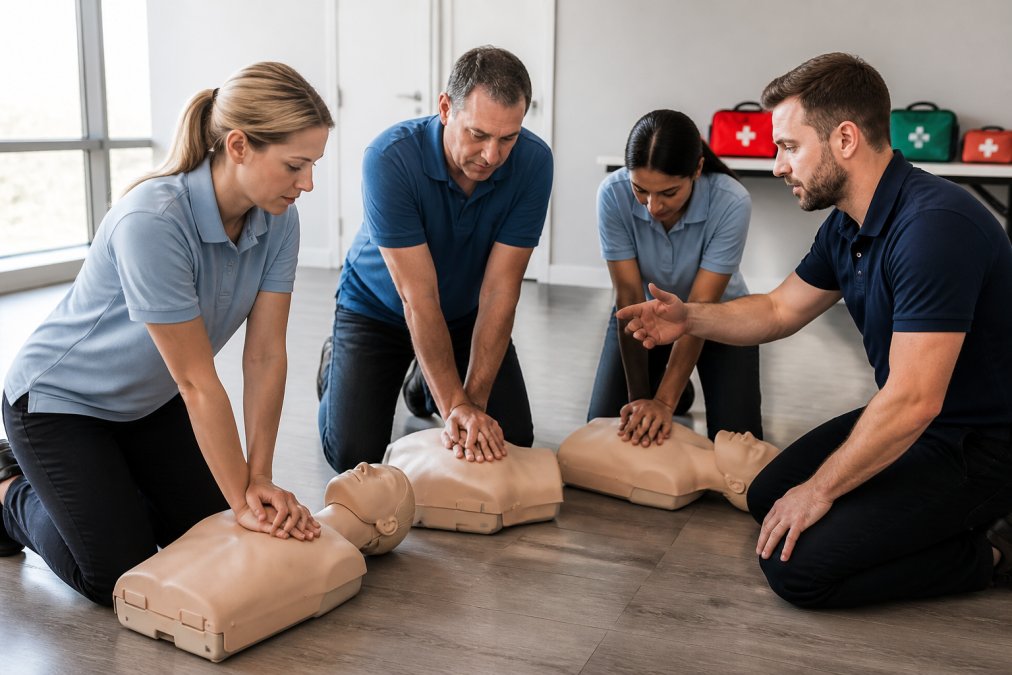
Core Skills: CPR, Bandaging and Defibrillator Use
CPR is the skill most beginners fear and the one they most need. You’ll practise chest compressions until the rhythm feels natural, usually around 100 to 120 compressions per minute.
Defibrillator training matters just as much. Modern AEDs talk you through every step, so the skill is really about confidence, not complexity.
Psychological First Aid and Support for Specific Demographics
Psychological first aid is the part most courses skip. It covers how to calm a distressed casualty, communicate clearly, and support people through shock while waiting for help.
Different groups need different handling too. Children, older adults, and people with disabilities all respond differently to injury and treatment. Good beginner training walks you through each.
Ask your trainer to run a scenario with a casualty who is panicking, not just one who is unconscious. Managing a frightened, awake person is the situation you’re most likely to face.
Step 2: Enrol in HLTAID011 Provide First Aid
HLTAID011 Provide First Aid is the nationally recognised unit that most workplaces require, and it’s the standard starting point for beginners. It sits within the Australian Quality Training Framework, which means the unit is delivered by a registered training organisation (RTO) and the certificate you receive is a statement of attainment, not a generic attendance record.
HLTAID011 replaced the older HLTAID003 Provide First Aid unit. If you hold an older code, most employers will still accept it until it expires, but new enrolments should always be for HLTAID011. The unit is made up of the skills and knowledge you’ll actually use: CPR, defibrillator use, bleeding control, shock management, burns, fractures, choking, anaphylaxis and asthma response, plus incident reporting and casualty assessment.
Enrolling is straightforward:
- Choose a registered training organisation (RTO), check the unit code and currency before you pay anything
- Complete your enrolment form and provide your Unique Student Identifier (USI)
- Pick a delivery mode that suits your schedule
- Confirm your booking and complete any pre-course reading
- Attend your session and complete the assessment
Eyzon Health & Safety delivers HLTAID011 through its partnership with Admire Workplace Safety RTO.
What the Assessment Actually Involves
Beginners often assume the assessment is a written exam. It isn’t. The bulk of it is practical demonstration, observed by your trainer, plus a short written or verbal knowledge component.
You’ll typically be asked to:
- Perform at least two minutes of uninterrupted CPR on an adult manikin, and demonstrate compressions on a child and infant manikin
- Use an AED following the voice prompts, including correct pad placement
- Manage a casualty who is bleeding, in shock, or choking
- Respond to a simulated anaphylaxis or asthma emergency
- Complete a basic incident report
Combining With Other Units
If you’re also chasing a White Card for construction work, ask about combining both. It saves you a second enrolment and a second trip. Some roles also require HLTAID012 Provide First Aid in an Education and Care Setting, which adds paediatric-specific content on top of HLTAID011. If you work with children, check which unit your employer actually wants before you enrol.
Step 3: Plan Around First Aid Course Duration and Delivery
First aid course duration for beginners typically runs about one day of face-to-face learning, or a shorter practical session if you complete the theory online first. Plan for a full day if you’re starting from scratch.
Delivery options break down like this:
| Delivery Mode | Time Commitment | Best For |
|---|---|---|
| Face-to-face | Full day, in person | First-timers who want hands-on guidance |
| Blended learning | Online theory plus short practical | Busy workers with irregular hours |
| Online theory only | Self-paced modules | Pre-study before your practical session |
Online vs. In-Person and Blended Learning
Blended learning suits most beginners best. You finish the theory at home, then attend a shorter practical session to demonstrate your CPR and bandaging skills.
Booking an online-only course that promises full certification without a practical assessment is a red flag. You’ll likely end up uncertified and out of pocket.
Step 4: Meet Workplace Safety Compliance Requirements
Workplace safety compliance in most industries means holding a current first aid certificate, and many roles require it before you can step on site. Work health and safety legislation places duties on employers to plan for emergencies, and trained first aiders are part of that plan.
What you need to know:
- First aid certificates are valid for three years from the date of issue
- CPR refreshers are recommended annually, because compression technique fades faster than the certificate does
- Some sites require evidence of your certificate before granting access
- Regulators such as Safe Work Australia set the framework that state and territory bodies enforce
- Construction, childcare, aged care, disability support and high-risk manufacturing roles almost always require current certification
Renewal and Refresher Timing
The three-year certificate and the annual CPR refresher are two different things, and beginners often confuse them. Your Provide First Aid certificate stays valid for three years, but many employers, particularly in childcare, aged care and construction, require evidence of a CPR refresher every 12 months.
What Employers Actually Check
When a site asks for your certificate, they’re usually checking three things: the unit code, the issue date, and the RTO that issued it. A statement of attainment from a registered training organisation covers all three. If you’ve trained through Eyzon Health & Safety, your certificate is issued via our partnership with Admire Workplace Safety RTO, so it carries the RTO details employers look for.
Step 5: Prepare Your Home First Aid Kit
A home first aid kit should cover cuts, burns, bites, and sprains without you having to hunt for anything. Build it once, check it every few months, and keep it somewhere everyone in the house knows.
Stock these essentials:
- Adhesive bandages in mixed sizes
- Sterile gauze pads and medical tape
- Antiseptic wipes and saline solution
- Triangular bandages for slings
- Disposable gloves
- Instant cold pack
- Tweezers and scissors
- Burn gel or dressing
- Emergency blanket
- A printed list of emergency contacts
Common Mistakes Beginners Make in First Aid Training
The biggest mistake beginners make is treating the course as a box to tick rather than a skill to build. That shows up in a few predictable ways.
- Rushing the online theory and skimming the practical
- Freezing during the CPR assessment because they never practised at home
- Forgetting that certificate renewal is due, then scrambling before a job starts
- Assuming any “first aid certificate” will be accepted on site
- Skipping the psychological first aid component because it feels less important
The skills fade faster than the certificate does. A short CPR refresher each year keeps you genuinely ready, not just compliant on paper.
Frequently Asked Questions
What are the 7 basic steps of first aid?
The seven steps are: check for danger, check responsiveness, call emergency services, open the airway, check breathing, start CPR if needed, and use a defibrillator (AED) if available. In first aid training for beginners, you practise each step until it feels automatic. You also learn to manage bleeding, burns and choking, and to keep the person comfortable until help arrives.
Do beginners need prior experience to enrol in a first aid course?
No prior experience is needed. Entry-level courses such as HLTAID011 Provide First Aid assume you have never done first aid before. Trainers explain the theory in plain language, then you practise hands-on with manikins and bandages. If reading or writing is a concern, tell the provider before you enrol so they can offer extra support.
How often do I need to renew my first aid certification?
Most Provide First Aid certifications stay current for three years, but CPR refreshes annually. This matters for workplace safety compliance, because many employers and site managers check that your CPR currency has not lapsed. Set a reminder a month before each expiry date so you can book a refresher without a gap in your certification.
How does Eyzon Health and Safety ensure quality training through their RTO partnership?
Eyzon Health and Safety partners with Admire Workplace Safety RTO to deliver nationally recognised training. That partnership means your course follows an accredited curriculum, your assessment is competency-based, and your statement of attainment is issued through a registered training organisation. Trainers also bring over 10 years of hands-on trade experience, so the practical examples reflect real worksites.