

Table of Contents
- Why Renew Your First Aid Certificate (And What Happens If You Don’t)
- First Aid Certificate Expiry Period: How Long Is Your Qualification Valid?
- Workplace First Aid Compliance Requirements: What the Law Says
- First Aid Training for Construction Sites: Renewal Considerations
- Step-by-Step: How to Renew Your First Aid Certificate
- Common Renewal Mistakes and How to Avoid Them
- Digital Certificate Management and Employer Reimbursement
- Frequently Asked Questions
Last Updated: September 19, 2026
Why Renew Your First Aid Certificate (And What Happens If You Don’t)
Knowing how to renew first aid certificate credentials matters more than most people think. Your certificate has an expiry date, and once it passes, you are no longer considered a current first aider at work.
First aid training is essential training required by law in most workplaces. Under work health and safety rules, employers must provide access to first aiders and first aid equipment. If your certificate lapses, you cannot fill that role.
This guide from Eyzon Health & Safety walks you through the whole process. We cover expiry periods, compliance rules, and the exact steps to renew.
So what happens if you let it slide?
- You lose your qualification to act as a workplace first aider
- Your employer may fall short of their legal duties
- You may need to redo the full course instead of a shorter refresher
- Some sites and job roles will turn you away without a current certificate
The good news: renewing is straightforward when you know the steps. Below, we break down exactly how to do it.
First Aid Certificate Expiry Period: How Long Is Your Qualification Valid?
A first aid certificate typically stays valid for three years from the date it is issued. The expiry period applies to the whole qualification, not just the CPR component.
Here is the catch most people miss: CPR needs an annual update. So even though your certificate lasts three years, your CPR skills must be refreshed every 12 months.
The table below shows how the two timelines work together.
|
Component |
Validity Period |
What You Must Do |
|---|---|---|
|
Full first aid certificate |
3 years |
Renew the full course before expiry |
|
CPR unit |
12 months |
Complete an annual CPR refresher |
HLTAID011 vs HLTAID009: What’s the Difference?
HLTAID011 is the unit for Provide First Aid. It covers the full scope: CPR, bleeding control, fractures, burns, and emergency response.
HLTAID009 is the unit for Provide Cardiopulmonary Resuscitation. It covers CPR only.
Most workplaces need HLTAID011. If you already hold it and only need to refresh your CPR, HLTAID009 is the shorter option.
Workplace First Aid Compliance Requirements: What the Law Says
Workplace first aid compliance requirements come from work health and safety legislation in every state and territory. The law requires businesses to provide first aid facilities, equipment, and trained staff, and first aid training is essential training required by law in every industry, not just high-risk ones.
The national reference point is the Safe Work Australia model Code of Practice on First Aid in the Workplace. Each state and territory regulator, SafeWork NSW, WorkSafe Victoria, WorkSafe Queensland, SafeWork SA, WorkSafe WA, WorkSafe Tasmania, WorkSafe ACT, and NT WorkSafe, enforces its own version of the same duties. The exact number of first aiders you need is not a fixed number in the legislation. It comes from a risk assessment that weighs:
- The nature of the work and the hazards on site
- The size and layout of the workplace
- How far workers are from medical help
- The number of people on site at any one time, including contractors and visitors
That is why a construction site with 30 workers needs different cover than a small office with five people, and why the same office may need more cover if it runs a warehouse, a workshop, or a client-facing floor.
Construction Sites: High-Risk WHS Obligations
Construction is classified as high risk, so the duties are stricter. A common pattern on larger sites is at least one trained first aider for every 20 workers, with a trained first aider on every shift and a first aid room or kit within reach of every work area.
Principal contractors usually build first aid into the site WHS management plan. That plan often lists the number of first aiders, their locations, and the nearest hospital or medical centre. On many sites, a current first aid certificate is a condition of entry, not just a nice-to-have.
Office Environments: Low-Risk but Still Mandatory
Offices are lower risk, but first aid is still required by law. A typical office needs at least one trained first aider on site during work hours, plus a stocked first aid kit, a designated first aid officer, and clear signage showing who to call.
The same duty applies across retail, hospitality, education, healthcare, warehousing, and trades. The risk assessment changes the numbers, not the obligation. If you are the only trained first aider in an office and your certificate lapses, your employer is exposed from that day forward.
First Aid Training for Construction Sites: Renewal Considerations
First aid training for construction sites comes with extra demands. The risks are higher, so the training needs to match.
When you renew, look for a course that covers:
- Severe bleeding and crush injuries
- Head and spinal injuries
- Burns and electrical injuries
- Heat stress and dehydration
- Falls from height
Construction workers often renew alongside their White Card and other site tickets. Planning them together saves time and keeps everything current.
Step-by-Step: How to Renew Your First Aid Certificate
Renewing takes a few clear steps. The sequence is the same whether you work on a construction site, in a warehouse, in a clinic, or in an office.
Step 1: Check Your Current Certificate and Expiry Date
Find your certificate and note the expiry date. If you are within three months of expiry, start now. Renewing before it lapses keeps your qualification current with no gap, and it avoids the risk of having to redo the full course instead of a shorter refresher.
Step 2: Choose a Registered Training Organisation (RTO)
Only an RTO can issue a nationally recognised statement of attainment. Before you pay, verify the provider on the national register at training.gov.au, search the RTO code and confirm the scope includes HLTAID011 Provide First Aid or HLTAID009 Provide Cardiopulmonary Resuscitation.
Eyzon Health & Safety partners with Admire Workplace Safety which is an accredited RTO.
Step 3: Complete Pre-Course Study and Provide Your USI
Most courses use a blended learning model. You complete the online theory, usually a few hours of reading, videos, and short quizzes, before you attend the practical session. Finishing the theory first means your classroom time is spent on hands-on skills, not on slides.
Step 4: Attend Practical Assessment and Get Your Certificate
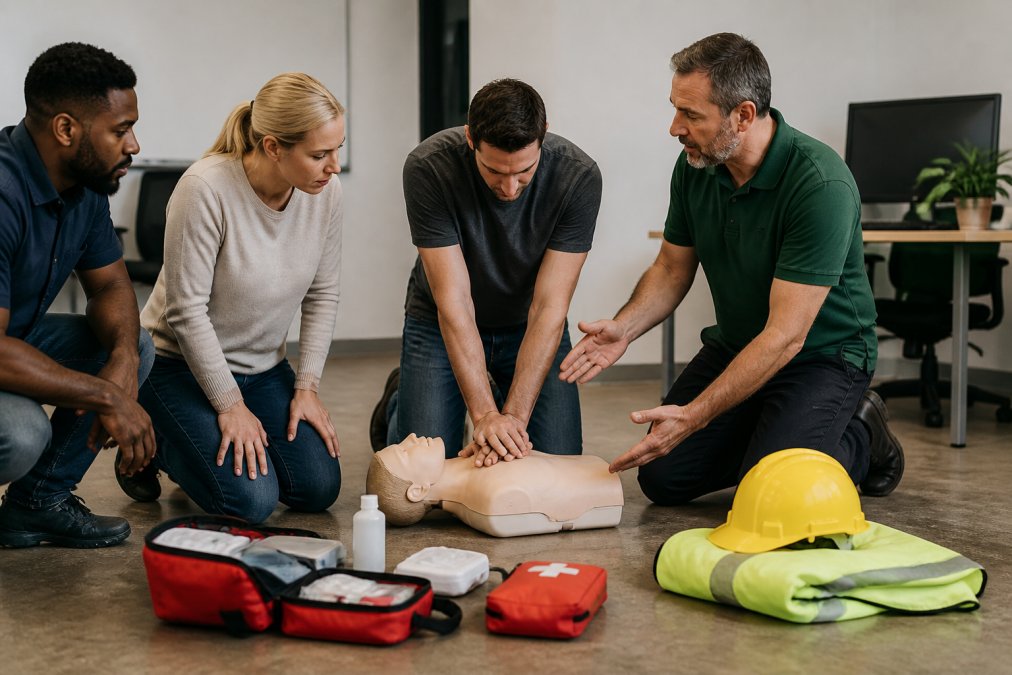
The practical session covers hands-on skills like CPR on a manikin, bandaging, use of an automated external defibrillator, and managing a casualty until help arrives. An assessor watches you perform each task to confirm competency.
Common Renewal Mistakes and How to Avoid Them
The biggest mistake is letting your certificate expire before you book. Once it lapses, you may need to redo the full course.
Other common slip-ups:
- Skipping the annual CPR update
- Booking with a provider that is not a registered RTO
- Forgetting to bring your USI
- Leaving the online theory until the last minute
- Not checking whether your employer will cover the cost
Digital Certificate Management and Employer Reimbursement
Store a digital copy of your certificate where you can find it fast. Many sites ask for proof before you start work.
Frequently Asked Questions
How often do I need to renew my first aid certificate?
Most first aid certificates, including HLTAID011 Provide First Aid, remain valid for three years from the date of issue. However, the CPR component (HLTAID009) must be renewed every 12 months. This means even if your overall certificate hasn’t expired, you still need to complete an annual CPR refresher to stay current. Many workplaces require this annual update as part of their compliance obligations.
What happens if my first aid certificate expires?
Once your certificate expires, you are no longer considered qualified to provide first aid in a workplace setting. If your role requires current certification, you may be unable to work until you complete a renewal or full course. For workplace compliance, having expired certificates can put your employer at risk of penalties under WHS legislation. It’s best to renew before the expiry date to avoid any disruption.
Is a refresher course the same as a full first aid course?
A refresher course is shorter and assumes you already hold a current or recently expired certificate. It focuses on updating your skills and knowledge, covering any changes in best practices. A full course is more comprehensive and is required if your certificate has been expired for a long period or if you’ve never held one. The specific requirements depend on the RTO and the unit of competency.
Do I need a USI to renew my first aid certificate?
Yes, you need a Unique Student Identifier (USI) to enrol in any nationally recognised training, including first aid renewals. If you don’t have one, you can apply for free on the Australian Government’s USI website. Your RTO will ask for your USI before issuing your statement of attainment. Without it, your certificate cannot be issued.
First aid certificates do not renew themselves, and a lapsed one can cost you work. At Eyzon Health & Safety, we make the process simple with flexible online and face-to-face options, same-day certificates on a successful pass, and trainers who explain things in plain language. Get started with Eyzon Health & Safety and keep your certification current and your workplace ready.