

Table of Contents
- Why Verifying a White Card Certificate Matters
- What You Need Before You Verify
- How to Verify a White Card Certificate Step by Step
- Digital vs Physical White Cards: Which One Can You Verify?
- The White Card Validity Period and What It Means for Your Site
- What to Do If You Need to Replace a Lost White Card
- Workplace Safety Compliance Checks for Employers
- When a White Card Check Fails: Troubleshooting Common Issues
- Frequently Asked Questions
Last Updated: September 26, 2026
Why Verifying a White Card Certificate Matters
Knowing how to verify a white card certificate protects your site, your licence and your workers. Under work health and safety law, a principal contractor must not let anyone onto a construction site without valid general construction induction training.
The card itself is not the proof. The record behind it is.
That distinction trips up a lot of people. A card can be expired, cancelled, or simply not belong to the person holding it. Checking the record takes two minutes and removes the risk.
This guide from Eyzon Health & Safety walks through the exact steps, the right portals, and what to do when a check fails. Eyzon Health & Safety also partners with Admire Workplace Safety to deliver training that stands up to scrutiny.
Accepting a photocopied card as proof is one of the most common compliance failures on site. If a worker is injured and their induction was never valid, the principal contractor carries the legal exposure.
What You Need Before You Verify
Gather three things before you start a check. Missing any one of them will stall the process.
- The card itself, or a clear photo of both sides
- Photo identification matching the name on the card
- The card number and issue date, printed on the front
For digital cards, you also need the worker’s Unique Student Identifier (USI). The USI links the training record to the person, so it is the fastest way to confirm a credential.
A common mistake is trying to verify from memory or a verbal description. Get the physical or digital card in front of you first.
How to Verify a White Card Certificate Step by Step
Verification follows three steps: confirm who issued the card, use the correct portal, then match and record the result. The whole process usually takes under five minutes once you have the card details.
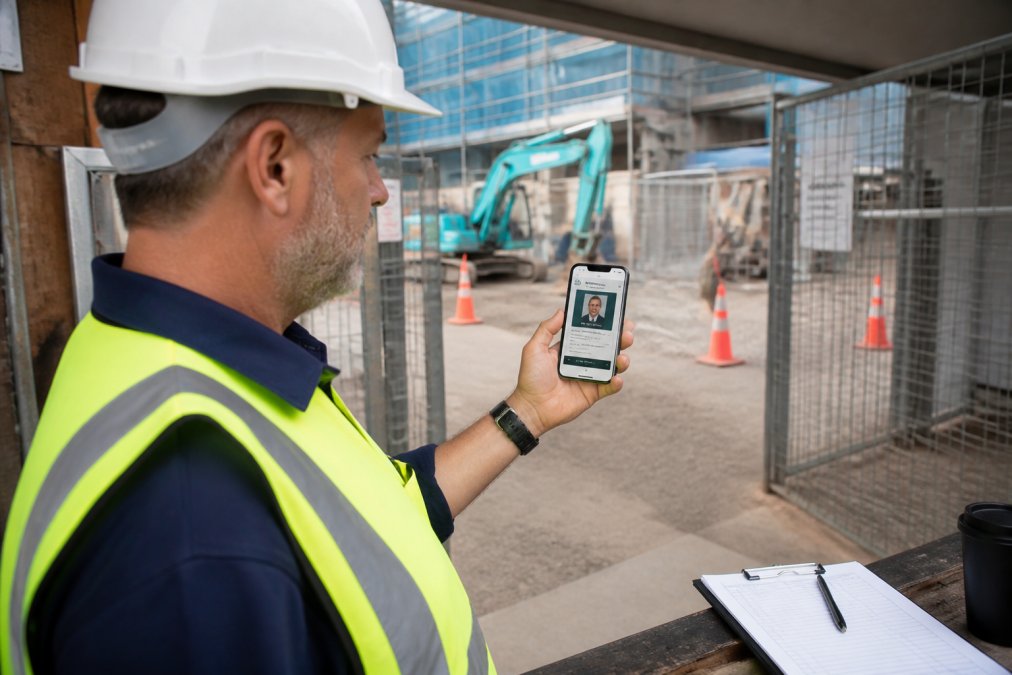
Step 1: Confirm the Card Issuer
Check which registered training organisation (RTO) issued the card. This matters because the RTO holds the training record, and you may need to contact them directly if the online portal returns nothing.
Look for the RTO name and code on the card. If the card was issued interstate, the issuing state’s safety authority is your starting point, not the state where the worker is standing.
Step 2: Use the Right Verification Portal
Each state and territory runs its own system. There is no single national lookup, which is the gap most guides skip over. Start with the portal for the state where the card was issued.
- New South Wales: SafeWork NSW maintains a white card verification service. You can search by card number or by the worker’s name and date of birth.
- Victoria: WorkSafe Victoria handles construction induction card checks through its own verification service.
- Queensland: WorkSafe Queensland runs a general construction induction register you can search online.
- Western Australia: WorkSafe WA manages construction induction card verification.
- South Australia: SafeWork SA handles construction induction verification.
- Tasmania: WorkSafe Tasmania manages the construction induction card register.
- Australian Capital Territory: WorkSafe ACT runs its own construction induction verification.
- Northern Territory: NT WorkSafe manages construction induction card checks.
SafeWork NSW white card verification service
WorkSafe Victoria construction induction verification
WorkSafe Queensland general construction induction register
Bookmark the portal for every state you hire from. If your workforce crosses borders, you will need more than one. A card issued in one state is generally recognised nationally, but the record still lives with the issuing state’s authority.
Step 3: Match Details and Record the Result
Enter the card number and confirm the name, date of issue and RTO match the card in front of you. Take a screenshot or note the date, time and result.
That record is your evidence of a workplace safety compliance check. Keep it with your site induction paperwork.
A portal returning a result is not the same as a card being valid for your site. Always cross-check the name on the record against photo ID before granting access.
Digital vs Physical White Cards: Which One Can You Verify?
Both can be verified, but digital cards are easier to check in real time. A digital card carries a USI and often a QR code, so you can confirm it on the spot.
Physical cards still work.
Ask for the USI rather than the card number when a worker presents a digital credential. The USI ties directly to the training record and cannot be transferred between people.
The White Card Validity Period and What It Means for Your Site
A white card does not expire in most states and territories, but that does not mean it stays valid forever. The card remains current as long as the holder keeps working in the industry and their record stays active.
What to Do If You Need to Replace a Lost White Card
Replacing a lost card is straightforward, and the training record usually survives the loss. You do not need to redo the course in most cases.
Follow these steps:
- Contact the RTO that issued the original card
- Provide photo ID and your USI
- Request a replacement card or a statement of attainment
- Keep the digital copy on your phone as backup
Workplace Safety Compliance Checks for Employers
Employers and principal contractors need a repeatable system, not a one-off check. Workplace safety compliance checks should happen before site access and be logged every time. The goal is a paper trail that survives an audit.
A Step-by-Step Verification Workflow
Build this into your onboarding so no worker slips through:
- Collect the card and photo ID before day one. Ask for both sides of the card and a matching photo ID.
- Identify the issuing state and RTO. Check the card for the RTO name and code, and note which state issued it.
- Run the check on the correct portal. Use the issuing state’s verification service, not the state you are working in.
- Match every field. Confirm the name, card number, issue date and RTO all match the card and ID.
- Record the result. Save a screenshot or PDF showing the date, time and outcome of the check.
- File it with the induction paperwork. Store the verification record alongside the worker’s site induction and any other compliance documents.
- Set a re-verification trigger. Re-check when a worker returns after a long break, changes roles, or presents a new card.
What to Keep for an Audit
A compliance audit will usually ask for evidence that you checked before granting access. Keep:
- A dated screenshot or printout of the verification result
- A copy of the card and photo ID used for the check
- The name of the person who performed the verification
- The worker’s induction record linked to the same file
A principal contractor who skips this step carries the legal responsibility if something goes wrong. The paper trail is your protection, and it is the first thing a regulator will ask to see.
Common Mistakes Employers Make
- Accepting a photocopy or photo of a card without checking the record
- Verifying on the wrong state’s portal and assuming a failed search means a fake card
- Failing to re-verify workers returning after a long absence
- Storing the check in a personal inbox rather than a central compliance file
Eyzon Health & Safety partners with Admire Workplace Safety to deliver nationally recognised White Card training, so the credentials your team holds are built to pass verification the first time.
When a White Card Check Fails: Troubleshooting Common Issues
A failed check does not always mean the card is fake. Most failures come down to four fixable problems.
| Problem | Likely Cause | Fix |
|---|---|---|
| No record found | Wrong state portal | Check the issuing state’s authority |
| Name mismatch | Name change or typo | Contact the issuing RTO |
| Card expired or inactive | Long break from industry | Arrange refresher training |
| USI not linked | Record never connected | Update USI with the RTO |
If a check fails and you cannot resolve it the same day, do not grant site access. Send the worker to a provider who can issue a nationally recognised statement of attainment quickly, and re-verify before they start.
Frequently Asked Questions
Can I verify a White Card certificate online?
Yes, in most states you can verify a White Card online through the relevant safety authority’s portal. You’ll typically need the cardholder’s name, card number and sometimes a date of birth. Some states also offer a public register or phone verification line. Always use the official safety authority website rather than a third-party site to confirm a card is current and nationally recognised.
How long does a White Card certificate last?
A White Card does not expire in most states and territories, so the white card validity period is generally ongoing once issued. However, some employers and principal contractors require workers to complete refresher training or provide evidence of recent site induction. Always check the specific requirements of the site you’re entering, as workplace safety compliance checks can vary between projects.
What should I do if my White Card cannot be verified?
First, check that you’re using the correct state or territory portal, because cards are issued by different safety authorities. Confirm your name is spelled exactly as it appears on your card. If the record still can’t be found, contact the RTO that issued your training or the relevant safety authority. They can confirm your certification status and help you replace a lost white card or correct a record error.
Do employers need to verify White Card certificates?
Yes. Under workplace health and safety laws, principal contractors and employers have a legal responsibility to ensure every worker on site holds valid construction induction training. This means running workplace safety compliance checks before allowing site access, keeping records of verification, and re-checking when new workers arrive. Failing to verify can lead to fines and serious safety risks.