

Table of Contents
- National Courses vs Allens Training: Key Differences
- What Makes Nationally Recognised Training Important
- Course Delivery and Flexibility Options
- White Card Course Duration and Structure
- White Card Assessment Requirements and Pathways
- How to Verify an RTO and Check Accreditation Status
- Choosing the Right Provider for Your Goals
- Frequently Asked Questions
Last Updated: October 8, 2026
National Courses vs Allens Training: Key Differences
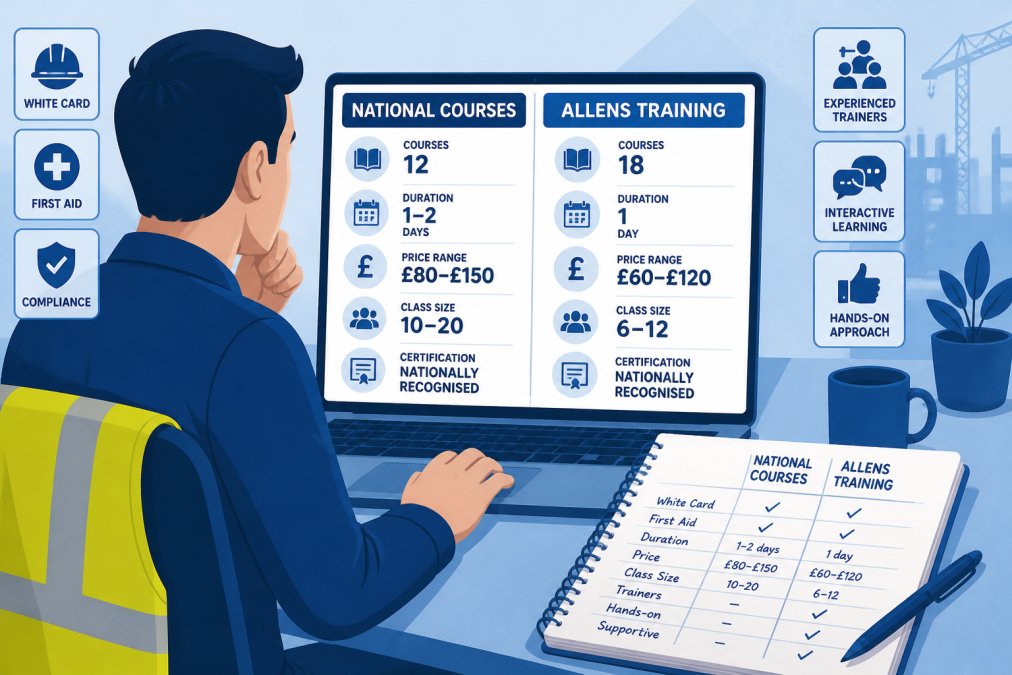
When comparing national courses vs allens training, choosing a training provider is one of the most important decisions you’ll make when pursuing nationally recognised qualifications. This comparison examines how National Courses and Allens Training stack up across delivery methods, course structure, assessment pathways, and accreditation status.
Both providers offer White Card and First Aid certifications, but they approach course design, trainer experience, and student support differently.
| Factor | National Courses | Allens Training |
|---|---|---|
| Delivery Options | Online, face-to-face | Online, face-to-face |
| Course Duration | Varies by course | Varies by course |
| Assessment Type | Practical and written | Practical and written |
| Certificate Timeline | Same-day on pass | Same-day on pass |
| Trainer Experience | Industry-experienced | Varies |
| Student Support | Online resources | Support available |
What Makes Nationally Recognised Training Important
Nationally recognised training isn’t just a credential, it’s proof that you’ve met standards set by the Australian Skills Quality Authority (ASQA). A statement of attainment from an accredited RTO tells employers you’ve completed assessed competencies in a regulated framework.
An unaccredited course might teach similar content, but it won’t satisfy the legal requirements for construction site access, childcare work, or aged care placements. Compliance with WHS legislation depends on holding qualifications from a registered training organisation.
Both National Courses and Allens Training operate as registered RTOs, so their courses meet ASQA standards. However, delivery quality, trainer expertise, and student outcomes can vary significantly even between accredited providers.
Course Delivery and Flexibility Options
Delivery mode changes what you are legally required to do, how long the course takes, and how much you can complete before meeting a trainer. For both providers, the practical differences sit in four areas: where knowledge is delivered, where practical assessment happens, how identity and USI verification are handled, and how much is self-paced versus scheduled.
Online knowledge, in-person practical. A common pattern across nationally recognised White Card and First Aid courses is a blended structure: theory online, then a short face-to-face or live-video practical session covering the performance evidence the unit requires. Some units cannot be assessed purely online, a trainer must observe you applying CPR on a manikin or identifying hazards in a simulated site walk-through.
Scheduled versus self-paced. Face-to-face delivery runs to a fixed timetable, predictable but inflexible. Self-paced online delivery lets you start and stop, but you carry the motivation. Ask each provider: what is the maximum time allowed to complete the online component before enrolment lapses? This is usually in the student handbook, and it is the most common reason learners end up paying twice.
Identity and USI requirements. Every nationally recognised course requires you to have a Unique Student Identifier (USI) before your statement of attainment can be issued. You can create or retrieve one through the USI registry. Both providers will ask for this at enrolment, and neither can issue a valid certificate without it. If you have studied or trained anywhere in the country before, you likely already have one.
Language, literacy and numeracy (LLN) checks. RTOs must assess whether a learner can complete the course before enrolment, in practice, a short online questionnaire or a phone conversation with a trainer. If you have been out of formal study for a while, ask what the LLN process involves and whether support is available.
Equipment and connectivity. Online delivery assumes a device with a camera and microphone, plus a stable connection for live sessions. If you’re completing the course from a site office or shared device, confirm whether the provider requires a private, quiet space for the practical observation component.
What to actually compare. Rather than asking “do you offer online and face-to-face?”, both do, ask these four questions of each provider and write the answers down side by side:
- How much of the course is self-paced, and how much is scheduled?
- Where and how is the practical assessment conducted?
- What is the deadline to complete the online component?
- What LLN or accessibility support is available if I need it?
The answers will usually separate the two providers faster than any marketing page.
Ask for the student handbook or course information document before you enrol. It contains the completion deadlines, assessment rules, and support contacts, the details that determine whether the course actually fits your schedule.
White Card Course Duration and Structure
White Card courses typically run one to two days, depending on provider and delivery method, covering construction site safety, hazard identification, emergency procedures, and your rights and responsibilities on site.
Most follow a similar structure: foundational safety knowledge, then practical scenarios and case studies, then assessment. Both National Courses and Allens Training compress this into a manageable timeframe that doesn’t require extended time away from work or study.
Duration varies by mode: online courses sometimes spread content across multiple sessions, while face-to-face programs often run as intensive single- or two-day events. Neither is inherently superior, it depends on your retention and availability.
What matters more than duration is depth. A rushed course that prioritises speed over understanding won’t serve you well on site facing real hazards.
White Card Assessment Requirements and Pathways
Assessment is where your competency gets measured. White Card assessment combines written tests, practical demonstrations, and sometimes scenario-based questions, you’re proving you can identify hazards and respond appropriately, not just memorising facts.
Both National Courses and Allens Training use ASQA-compliant assessment methods, so standards are consistent, but the experience differs: some providers use computer-based tests, others paper; some include role-play, others rely on written responses.
The assessment pathway determines how quickly you can get certified. Most providers issue same-day certificates on successful completion, which is crucial if you have a job lined up. If you don’t pass first time, understand the reassessment process, some providers offer it free, others charge additional fees.
Ask specifically about assessment structure and what happens if you need to retake the test, this detail is often overlooked but affects your experience and costs.
Before enrolling, confirm the exact assessment format and whether reassessment is included in your course fee. Knowing this upfront prevents surprises if you need a second attempt.
How to Verify an RTO and Check Accreditation Status
Accreditation verification is your first line of defence against wasting time and money on unrecognised qualifications.
To verify an RTO’s registration, visit the ASQA’s Register of Registered Training Organisations. Search by the provider’s name or RTO code. A legitimate RTO will appear in this register with current accreditation status. If a provider doesn’t appear here, their qualifications won’t be nationally recognised, and employers won’t accept them.
Check more than the name: verify which courses the provider is accredited to deliver. Some RTOs are registered broadly, others have limited scope. National Courses and Allens Training both appear on the ASQA register, but confirm their specific accreditations cover the White Card or First Aid course you’re considering.
You can also check SafeWork NSW approved providers to confirm whether a White Card provider meets state-specific requirements. This additional verification step ensures your certificate will be accepted on construction sites across the state.
Beyond the register, look at independent reviews and student feedback. Accreditation proves a provider meets minimum standards, but not whether trainers are engaging, support is responsive, or you’ll feel confident on site afterwards.
Never enrol with a provider you can’t verify on the ASQA register. Unaccredited training won’t satisfy legal requirements for site access, and you’ll need to redo the course with a legitimate RTO before you can work.
Choosing the Right Provider for Your Goals
What actually helps is a short, repeatable method for comparing two registered training organisations on the factors that affect your outcome, and a clear-eyed view of which learner type each provider suits.
A four-step comparison method.
- Verify registration and scope. Look up each provider on the ASQA Register of Registered Training Organisations and confirm the specific course code you intend to enrol in appears in their scope. Registration is provider-level; scope is course-level. A provider can be registered and still not be approved to deliver the unit you want.
- Confirm the certificate is nationally recognised. Ask for the unit code (for example, the White Card unit and the relevant First Aid units) and check that the code matches the one listed against the provider’s scope. If a provider cannot give you a unit code, treat that as a red flag.
- Check state-specific requirements where they apply. Construction induction cards are issued under state and territory WHS regulators, and acceptance rules differ. If you plan to work across borders, confirm with the relevant regulator that your card will be recognised, SafeWork NSW, for example, maintains its own approved provider arrangements.
- Read reviews as a signal, not proof. Review sites capture individual experiences, a great trainer on a good day, or a bad experience caused by a scheduling clash. Use them to generate questions, not verdicts. A repeated complaint across many reviews is meaningful; a single one-star review is not.
Match the provider to your learner type. The “best” provider depends on which of these describes you:
- You need certification fast because a job starts soon. Prioritise providers who issue statements of attainment same-day on successful completion, and confirm this in writing before you pay. Ask what happens if you do not pass on the first attempt.
- You have been out of study for years. Ask about LLN support, whether trainers are contactable between sessions, and whether the online component can be paused. Support responsiveness matters more to you than course duration.
- You are studying around shift work or remote location. Prioritise self-paced online delivery with a generous completion window, and confirm the practical assessment can be scheduled around your roster.
- You want a trainer who has worked on site. Ask directly about trainer backgrounds. Some providers employ trainers with current or recent industry experience; others rely on career educators. Neither is automatically better, but the fit differs.
- You are renewing an existing qualification. Check whether the provider offers a refresher or recognition of prior learning (RPL) pathway, and what evidence you need to supply.
What to record before you decide. For each provider, write down the unit code, delivery mode, practical assessment location, completion deadline, reassessment policy, and support contact. If a provider can’t answer one clearly, that’s useful information.
A note on sourcing. Provider details, registration status, and course scope change. Before relying on any comparison, including this one, check the ASQA register and the provider’s current course information page, and note the date you checked. Review-site ratings are opinions collected at a point in time, not evidence a course meets your needs.
Our trainers bring over 10 years of hands-on trade experience, and our online and face-to-face options share the same practical assessment standard. Whichever provider you choose, National Courses, Allens Training, or Eyzon Health & Safety, verify the registration, confirm the unit code, and check the completion terms before you enrol.
The fastest way to compare two providers is to ask both the same six questions: unit code, delivery mode, practical assessment location, completion deadline, reassessment policy, and support contact. The provider that answers all six clearly is usually the one that will support you through the course.
Frequently Asked Questions
How can I check whether a safety course is nationally recognised?
Check the Australian Skills Quality Authority (ASQA) register to verify the training provider is a registered training organisation (RTO). Look for the provider’s registration number and confirm their courses are listed in the national training database. A nationally recognised qualification means your statement of attainment will be accepted by employers and meets WHS compliance requirements across Australia.
How long does it take to complete a White Card course?
White Card course duration typically ranges from one day to several weeks, depending on delivery mode and provider structure. Full-time face-to-face courses often take one to two days, while online or part-time options may extend over several weeks. Check your chosen provider’s course schedule to confirm exact timelines, especially if you have a job start date approaching.
Will my training certificate be accepted by employers?
Yes, if your course is delivered by a registered training organisation (RTO). Employers recognise nationally recognised statements of attainment from accredited providers. Before enrolling, verify the provider’s RTO status on the ASQA register. Certificates from unregistered providers may not be accepted on construction sites or by major contractors.
What should I look for when comparing training providers?
Assess RTO accreditation status, course delivery options (online, face-to-face, or hybrid), assessment methods, trainer experience, student support availability, and how quickly you can receive your certificate. Consider whether the provider offers flexible scheduling to fit your work commitments, and check reviews from past students about the learning experience and course quality.