

Table of Contents
- What Is a SWMS in Construction Safety?
- High Risk Construction Work Examples: When a SWMS Is Required
- Who Prepares a SWMS and Who Signs It?
- How to Write a Safe Work Method Statement: Step-by-Step
- SWMS Template Construction: What to Include and Common Pitfalls
- Implementing, Reviewing and Training Workers on Your SWMS
- Conclusion
- Frequently Asked Questions
Last Updated: September 19, 2026
What Is a SWMS in Construction Safety?
If you have ever asked what is SWMS in construction safety, the answer is a written document that lists the high-risk construction work being done on site, the hazards each task creates, and the controls that keep workers safe. In construction safety, a SWMS is a legal requirement under the Work Health and Safety Regulations, and SafeWork NSW expects one for every high-risk activity before work starts (Prepare safe work method statement).
How a SWMS Differs from a JSA or Risk Assessment
Understanding what is SWMS in construction safety starts here: it is task-specific and legally required for high-risk work. A Job Safety Analysis (JSA) is a broader, often voluntary tool for breaking down everyday tasks. A risk assessment is the wider process of spotting hazards and rating them.
The key differences:
- SWMS: Required by law for high-risk construction work. Must be site-specific and signed.
- JSA: Often used for routine tasks. Not a legal substitute for a SWMS.
- Risk assessment: The umbrella process. A SWMS is one output of it.
High Risk Construction Work Examples: When a SWMS Is Required
A SWMS is required whenever construction work is high risk. Under the Work Health and Safety Regulations, high risk construction work (HRCW) covers 18 defined activities. If any apply to your task, you need a SWMS before work begins.
Typical examples include but not limited to:
- Work at heights over two metres
- Work near live electrical services
- Demolition of load-bearing structures
- Trenching deeper than 1.5 metres
- Work in confined spaces
- Work near traffic or mobile plant
The 18 HRCW Activities Under the WHS Regulations
The regulations list 18 activities that trigger a SWMS. They range from structural work to work near essential services. Rather than memorise all 18, check the regulation directly. When in doubt, write one. Over-documenting is cheaper than a fine.
Who Prepares a SWMS and Who Signs It?
The person conducting a business or undertaking (PCBU) must prepare or approve the SWMS. In practice, a site supervisor or safety officer drafts it, and the principal contractor reviews it. Workers who will do the task must be consulted and sign on.
Consultation and Duty of Care Requirements
Consultation is a legal duty, not a courtesy. The PCBU must talk to workers who will carry out the task, and to anyone else affected. Workers often spot hazards that a desk-based draft misses.
Your duty of care means you must:
- Identify hazards with the people doing the work
- Agree on controls using the hierarchy of controls
- Check controls are followed on site
- Stop work if controls fail
How to Write a Safe Work Method Statement: Step-by-Step
Writing a SWMS follows a clear sequence, and the sequence matters because an inspector will check the document against the content requirements in the Work Health and Safety Regulation. Start with the task, not the template. A blank form invites guesswork; a defined task keeps the document tight and usable.
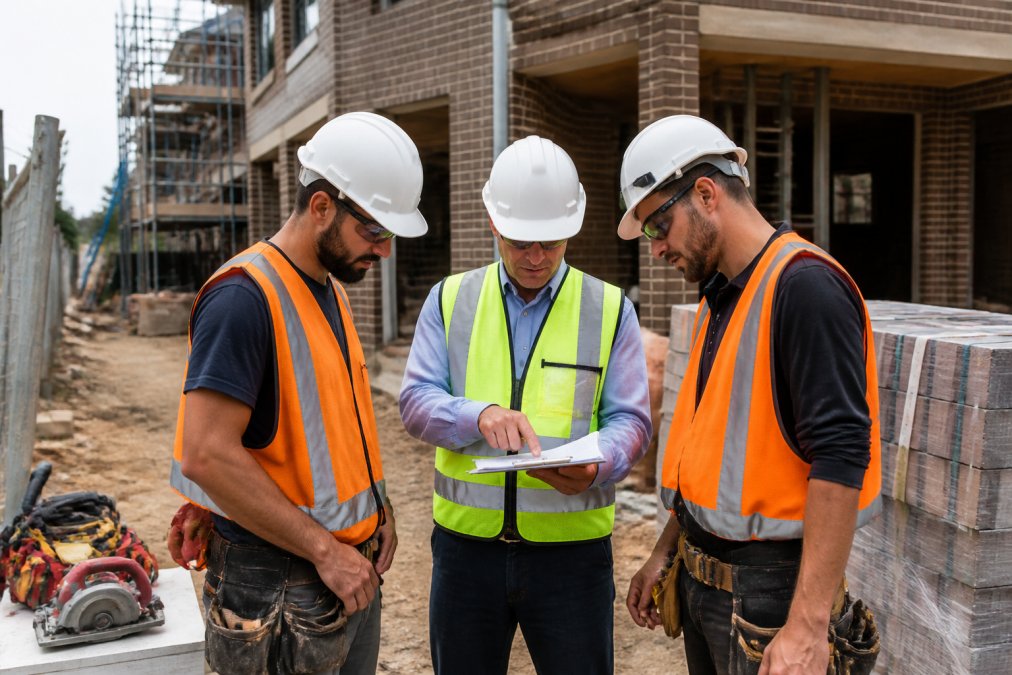
What you’ll need:
- The task description and site address
- Relevant regulations and codes
- Your workers’ input
- A SWMS template or digital form
Follow these steps:
- Describe the task. Name the activity and where it happens. Be specific enough that a worker who has never been to the site can picture the job.
- List the HRCW triggers. Note which of the 18 activities under the WHS Regulation apply. If none apply, you likely do not need a SWMS, but document your reasoning.
- Identify hazards. List every hazard the task creates, including hazards introduced by the controls themselves (for example, a harness creating a suspension trauma risk).
- Set control measures. Apply the hierarchy of controls for each hazard: eliminate, substitute, isolate, engineer, administrate, then PPE as the last line.
- Name the responsible person. Who checks the controls on the day? A control with no owner is a control that will not be checked.
- Add emergency details. First aid, evacuation routes, rescue arrangements for work at height or confined space, and emergency contacts.
- Consult and sign. Walk workers through it, answer questions, and collect signatures before work starts.
- Store and review. Keep it on site, make it accessible to workers, and update it when anything changes.
What the WHS Regulation Actually Requires in the Document
The content requirements are not optional extras. Under the Work Health and Safety Regulation, a SWMS must:
- Identify the work that is high risk construction work
- State the hazards relating to that work
- Describe the control measures to be implemented
- Describe how the control measures will be implemented, monitored, and reviewed
- Be prepared in consultation with workers who will carry out the work
- Be reviewed and, if necessary, revised whenever there is a change to the work, a hazard, or a control measure
- Be kept available for inspection
The 18 HRCW Activities Under the WHS Regulations
The regulations list 18 activities that trigger a SWMS. They include work at height over two metres, work on or near energised electrical installations, demolition of load-bearing structures, trenching deeper than 1.5 metres, work in confined spaces, work near traffic or mobile plant, work in or near a shaft or trench with an excavation depth greater than 1.5 metres, and work on or near pressurised gas mains or piping.
SWMS Template Construction: What to Include and Common Pitfalls
A good SWMS template includes the task, hazards, controls, responsible people, and signatures. The template is a starting point, not the finished product. The content must reflect your actual site.
What to include:
- Site address and task description
- HRCW triggers
- Hazard and control table
- Responsible person for each control
- Emergency and first aid details
- Sign-off section for workers
Common pitfalls to avoid:
- Copying another site’s SWMS without changes
- Skipping the HRCW trigger list
- Vague controls like “be careful”
- No signatures
- Never reviewing it after a change
Digital vs Paper SWMS on Site
Digital SWMS platforms let you update controls and capture signatures on a tablet. Paper is simple and needs no power. The right choice depends on your site.
|
Format |
Best For |
Drawback |
|---|---|---|
|
Paper |
Small crews, no connectivity |
Hard to update, easy to lose |
|
Digital |
Multi-site teams, live updates |
Needs devices and training |
|
Hybrid |
Most sites |
Requires clear version control |
Implementing, Reviewing and Training Workers on Your SWMS
A SWMS only works if the crew follows it. Implementation means briefing workers before the task starts, checking controls during the work, and stopping the job when controls fail. Review it whenever the task, site, or crew changes. This is the part most sites get wrong, and it is where the gap between a compliant document and a safe site actually shows.
Briefing the Crew Before Work Starts
The briefing is not a signature collection exercise. Walk the crew through the task, the hazards, and the controls, then ask each worker to describe what they will do if a control fails. If they cannot answer, the briefing has not landed. Keep the briefing short, use plain language, and translate or visually demonstrate where literacy or language barriers exist. A toolbox talk format works well for this.
Monitoring Controls During the Work
Someone must own the check. The responsible person named in the SWMS should verify controls at the start of the shift and again when conditions change. Common failure points include:
- Harness anchor points not inspected before use
- Exclusion zones eroded as the job progresses
- Traffic management plans not adjusted when deliveries arrive
- Confined space gas monitoring skipped on short entries
Training Workers on the SWMS
Training is the missing piece on many sites. Workers need to know how to read a SWMS, how to raise a concern, and what to do when controls fail. A short toolbox talk covers the basics. For anyone new to site work, a White Card course builds the foundation, and Eyzon Health & Safety delivers that training with trainers who have over 10 years of hands-on trade experience.
A practical training approach:
- Brief the SWMS at the start of the task, not days earlier
- Use the actual site and the actual crew, not a generic video
- Ask workers to point out hazards the document missed
- Record attendance and any concerns raised
- Re-brief after any incident, near miss, or change to the work
Reviewing and Revising the SWMS
Review your SWMS when:
- The task changes
- New hazards appear
- An incident or near miss occurs
- A worker raises a concern
- The site layout or access changes
- A control measure is found to be ineffective
A review does not always mean a rewrite. It means checking whether the document still reflects the work. If it does, note the review date and move on. If it does not, revise it, re-consult the workers, and re-sign.
A SWMS is a living document. If it never changes, it is probably not being used. The sites that pass inspection are the ones where the crew can explain the controls without reading from the page.
Conclusion
Getting a SWMS right takes practice, and the rules are strict. SafeWork NSW expects a site-specific document with real controls and signed sign-off. Eyzon Health & Safety helps workers and supervisors build that knowledge from the ground up, with nationally recognised White Card and First Aid training, flexible online and face-to-face delivery, and same-day certificates on a successful pass.
Frequently Asked Questions
What does SWMS stand for in construction?
SWMS stands for Safe Work Method Statement. It is a written document that identifies the high risk construction work activities on a site, the hazards associated with each activity, and the risk control measures that will be put in place. Under the Work Health and Safety Regulations, a SWMS must be prepared before any high risk construction work begins and must be reviewed and revised whenever there is a change to the work, the hazards, or the control measures.
Who is responsible for preparing a SWMS?
The person conducting a business or undertaking (PCBU) is responsible for ensuring a SWMS is prepared for all high risk construction work. In practice, this duty is often delegated to a site supervisor, principal contractor, or the subcontractor carrying out the work. Whoever prepares it must consult with the workers who will perform the task, because they know the site conditions and the practical hazards best. The SWMS must be signed by the PCBU or their representative before work starts.
Is a SWMS a legal requirement for all construction work?
No. A SWMS is only legally required when the work meets the definition of high risk construction work under the Work Health and Safety Regulations. Examples include working at heights over two metres, demolition, and excavation deeper than 1.5 metres. For lower-risk tasks, a risk assessment or job safety analysis may be sufficient. SafeWork NSW provides guidance on which activities trigger the requirement, and you should check the current rules before starting any job.
What specific information must be included in a SWMS?
A compliant SWMS must state the high risk construction work activities, specify the hazards and risks for each activity, describe the risk control measures to be implemented, explain how the control measures will be monitored and reviewed, and list the names of the people who will carry out the work. It must also record the date it was prepared and be signed by the relevant parties. SafeWork NSW recommends keeping it site-specific rather than relying on a generic template.