

Table of Contents
- What the White Card Actually Requires (and What It Doesn’t)
- White Card Language and Literacy Support: What Trainers Can Offer
- Interpreters for Construction Induction Training: What You Need to Know
- How to Find Inclusive White Card Training That Works for You
- Step-by-Step: Applying for Your White Card When Reading Is Hard
- Interstate Recognition, Employer Funding and Other Practical Matters
- Frequently Asked Questions
Last Updated: September 19, 2026
What the White Card Actually Requires (and What It Doesn’t)
Getting a White Card with white card literacy barriers is more achievable than most people expect. The White Card is a nationally recognised construction induction certificate. It proves you understand basic workplace health and safety before you step onto a construction site.
What the White Card does not require:
- A written essay or long-form reading test
- High school completion or any formal qualification
- Fluent English reading skills
What it does require:
- The ability to understand and respond to safety information
- Photo ID for identity verification
- Completion of an accredited course with a registered training organisation (RTO)
White Card Language and Literacy Support: What Trainers Can Offer
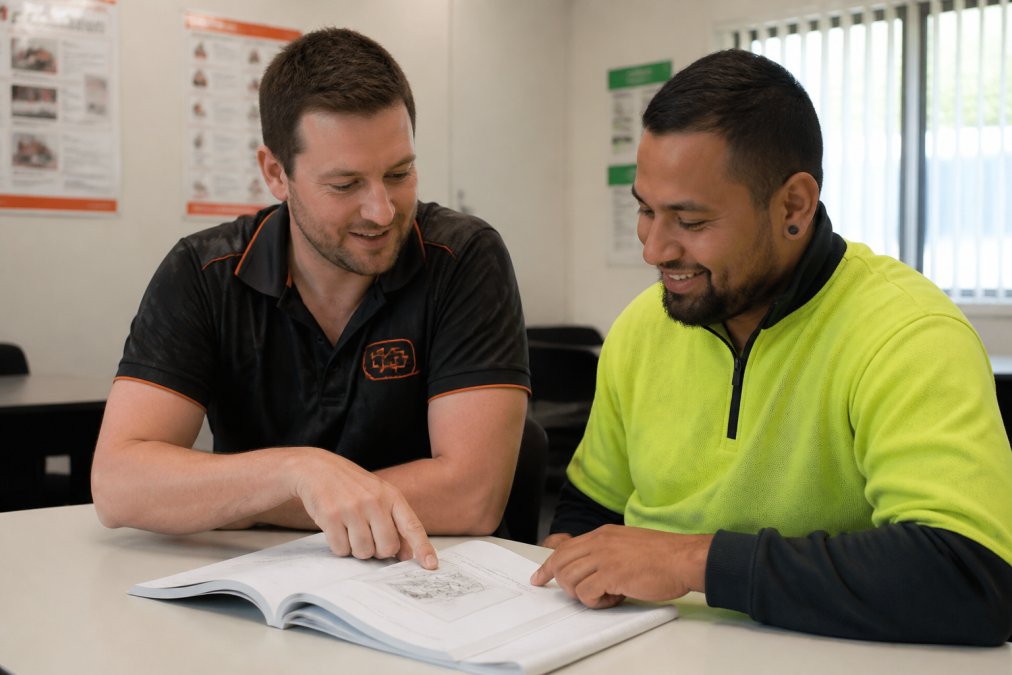
Trainers can adjust how training and assessment are delivered so that reading and writing difficulties don’t block your certification. The key word is “reasonable adjustments.”
Reasonable Adjustments During Training and Assessment
Reasonable adjustments are changes to how training is delivered or how you’re assessed. They don’t change what you need to learn. They change how you show you’ve learned it.
Common adjustments include:
- Verbal instructions instead of written ones
- One-on-one support from the trainer
- Extra time to complete activities
- Oral assessment instead of written answers
- Visual aids and diagrams
- A support person who can read questions aloud
Interpreters for Construction Induction Training: What You Need to Know
If English isn’t your first language, you can bring an interpreter to your construction induction training. But the interpreter must meet specific requirements, and getting this wrong is one of the most common reasons a learner is turned away on the day.
NAATI Certification and Why It Matters
Yes, interpreters need NAATI approval. NAATI is the National Accreditation Authority for Translators and Interpreters, the body that certifies translators and interpreters in Australia. SafeWork NSW expects that anyone interpreting safety information during construction induction training holds current NAATI certification, because safety terms need precise translation, not guesswork.
Two distinctions matter here, and most guides skip them:
- Translator vs interpreter. A translator works with written text. An interpreter works with spoken language in real time. For a face-to-face or virtual classroom course, you need an interpreter, not a translator.
- Certification level. NAATI certifies at different levels. For general conversation, a lower level may be enough. For a construction induction course full of technical safety terminology, hazard identification, risk controls, PPE, emergency procedures, you want a Certified Interpreter (formerly known as Professional Interpreter) or above. A Certified Provisional Interpreter may be accepted for straightforward sessions, but confirm with your RTO before you book.
Why this matters:
- An uncertified interpreter may not accurately convey safety information, which is a safety risk on site
- Your RTO may refuse to accept an uncertified interpreter, wasting your booking
- Safety terms need precise translation, not guesswork
- Some RTOs will only accept interpreters at a specific NAATI level, and the level varies between providers
Questions to Ask Before You Book
Before you book training, ask your provider:
- Do they allow interpreters in the session?
- What NAATI certification level do they require?
- Do they provide interpreters, or do you arrange your own?
- Is there an extra fee for bringing an interpreter, or for the provider arranging one?
- Can the interpreter sit in for the whole session, including the assessment?
Some RTOs have bilingual trainers or can arrange interpreter support. Others ask you to bring your own. Either way, confirm this before enrolment so there are no surprises on the day.
If you’re arranging your own interpreter, ask them for their NAATI certification number and level before you confirm the booking. Give that number to your RTO in advance so they can verify it. Turning up with an interpreter the RTO won’t accept is one of the most avoidable ways to lose a training day.
An interpreter is there to interpret, not to answer questions for you or complete your assessment. The RTO still needs to assess your own competency. If an interpreter starts coaching you through answers, the RTO can stop the assessment.
If You Can’t Arrange an Interpreter
Not every learner can find a NAATI-certified interpreter in their language at short notice. In that case, ask the RTO about:
- Bilingual trainers who speak your language
- Oral assessment with a support person who reads questions aloud (this is a reasonable adjustment, not an interpreter role)
- Whether the RTO can recommend an interpreter agency they’ve worked with before
SafeWork NSW construction induction training guidance
How to Find Inclusive White Card Training That Works for You
Finding the right training provider comes down to three things: how they teach, what support they offer, and whether they’re properly accredited.
Use this checklist when comparing providers:
- Are they a registered training organisation (RTO)?
- Is the course CPCWHS1001, the nationally recognised construction induction unit?
- Do they offer face-to-face training or virtual classroom options?
- Can they provide literacy and language support?
- Do they allow NAATI-certified interpreters?
- Do they issue your statement of training and card on the same day?
- Are they approved by SafeWork NSW?
Ask the provider directly: “What support do you offer someone who struggles with reading?” Their answer tells you everything. A good provider will have a clear, specific response. A poor one will dodge the question.
Step-by-Step: Applying for Your White Card When Reading Is Hard
Follow these steps in order. Each one builds on the last, and the notes under each step flag the points where literacy barriers most often cause problems.
- Choose an accredited RTO that offers language and literacy support. Check the RTO’s registration on the national training register before you pay anything.
- Get your USI (Unique Student Identifier). This is a government-issued number you need before enrolling. You can create one online, and it’s free. If you find the online form hard to read, ask a support person to sit with you, the USI office also has phone support.
- Enrol and tell them about your needs. Mention any reading, writing, or language support you require. Ask about interpreters if needed. Do this at enrolment, not on the day.
- Gather your ID. You’ll need at least one form of photo identification for identity verification. Make sure the name on your ID matches the name on your USI and enrolment exactly.
- Complete the training. This covers hazard identification, risk management, PPE requirements, and construction site safety. Ask for verbal instructions or visual aids if written material is slowing you down.
- Complete the assessment. This may be verbal, written, or a mix, depending on your adjustments. If you’ve arranged oral assessment, confirm it in writing before the day.
- Receive your statement of training. This is your temporary proof while your card is processed. Keep it somewhere safe, you may need to show it on site.
- Receive your White Card. SafeWork NSW issues the card, and it’s posted to you.
The Timeline Most Guides Don’t Explain
There are two separate things people confuse: the statement of training and the physical card.
- Statement of training, issued by your RTO, usually on the day you complete the course. This is what lets you start work while you wait for the card.
- Physical White Card, issued by SafeWork NSW and posted to the address on your application. Postage typically takes a couple of weeks, and it can take longer if your details don’t match or your photo is rejected.
What to Do If Your Application Gets Rejected
Rejections usually happen for simple reasons. Here are the most common fixes:
| Problem | Likely Cause | Fix |
|---|---|---|
| No USI on record | USI not created or not linked to your enrolment | Create or verify your USI, then re-submit |
| USI verification fails | Name, date of birth, or ID details don’t match between USI and enrolment | Log into the USI registry and correct your details, then ask the RTO to re-verify |
| ID not accepted | Insufficient or expired documents | Provide current photo ID |
| Interpreter not accepted | Interpreter lacks NAATI certification, or is at the wrong level | Book a NAATI-certified interpreter at the level your RTO requires |
| Training not recognised | Provider not properly accredited | Check the RTO’s registration status |
| Details don’t match | Name or date of birth errors | Correct your details with the RTO before the card is printed |
If your USI verification fails, don’t re-enrol. Fix the mismatch in the USI registry first, then ask your RTO to re-verify. Re-enrolling with a fresh USI creates a second record and makes the problem harder to untangle.
Never enrol with a provider that isn’t a registered training organisation. If your course isn’t accredited, your card won’t be accepted on site, and you’ll have to pay again to do it properly.
Interstate Recognition, Employer Funding and Other Practical Matters
A White Card issued in one state or territory is recognised across Australia. This is because construction induction training is nationally recognised under CPCWHS1001. You don’t need to redo the course if you move interstate.
Frequently Asked Questions
Can I get assistance if I have difficulty reading or writing during my White Card course?
Yes. Registered training organisations must make reasonable adjustments for learners with literacy barriers. This can include verbal assessments instead of written ones, extra time to complete tasks, one-on-one support from a trainer, or simplified learning materials. Tell your training provider about your needs before the course starts so they can arrange the right support. The goal is to assess your understanding of construction site safety, not your reading level.
Do I need a professional translator for my White Card training?
If English is not your first language and you need an interpreter, the interpreter should hold NAATI certification. NAATI is the national accreditation authority for translators and interpreters. Some training providers can arrange a NAATI-certified interpreter for you, while others may ask you to bring your own. Contact the RTO before enrolling to confirm what interpreter support they offer and whether there is any additional arrangement needed.
What kind of support can training providers offer for literacy barriers?
Support options vary by provider but commonly include verbal questioning instead of written tests, visual aids and diagrams, simplified language materials, additional time, and dedicated one-on-one assistance. Some providers also offer pre-course language and literacy screening so they can tailor support from day one. Ask specifically what adjustments are available and whether the trainer has experience working with learners who need extra reading and writing help.
How do I notify my training provider about my literacy needs?
Contact the training provider before you enrol, either by phone or in person if writing is difficult. Explain that you need support with reading or writing and ask what adjustments they can make. Many RTOs have a simple enrolment form where you can tick a box for additional support. If you are not comfortable discussing it upfront, you can also tell the trainer privately on the first day, though earlier notice gives them more time to prepare.